What to Drink Instead of Alcohol
Category-level ideas for non-alcoholic drinks at home, at a bar, or with friends when you are cutting back without brand recommendations.
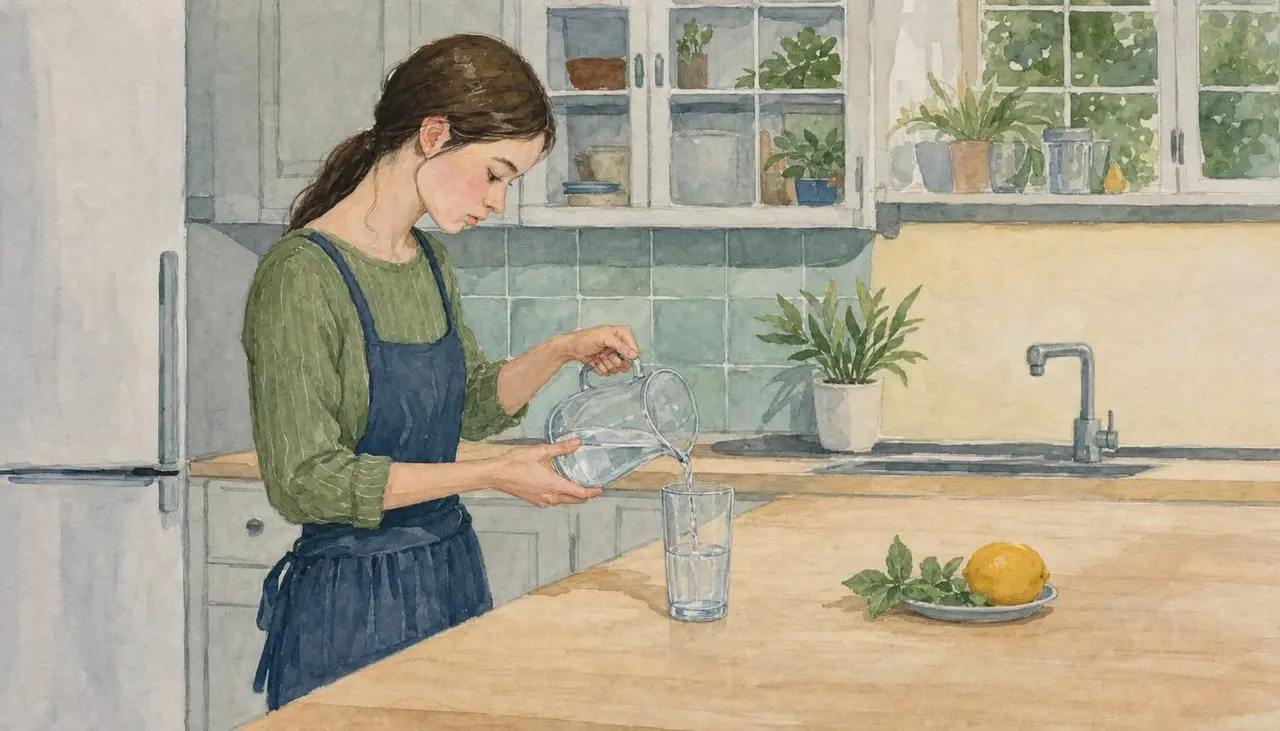
It's 5:40 on a Tuesday. Work is over but the evening hasn't started, the kitchen has that in-between feeling, and your hand knows exactly where it's going before you've decided anything. The cold shelf. The familiar bottle. The pour is the plan — it has been for a while.
Here's the workable part: most of what that drink does for you has nothing to do with alcohol. It's the cold in your hand, the specific glass, the signal that you're off duty now. That's not weak willpower — it's a routine you've rehearsed in the same room, at the same hour, hundreds of times. So the question of what to drink instead of alcohol is less about finding one perfect beverage and more about filling the same slot with something else — on purpose, ahead of time. Call it the Glass Swap: four moves. Name the job, stock the swap, order by category, keep a line ready.
Why the ritual matters more than the flavor
A habitual drink runs as a loop. There's a cue — the clock, the room, the first quiet minute after the laptop closes. There's a ritual — the pour, the glass, the first sip. And there's a payoff — the evening gets its hinge, the day officially ends. Alcohol is only one ingredient in that loop, and often not the main one.
An urge to pour also tends to crest and fade like a wave — NIAAA's Rethinking Drinking describes urges to drink as short-lived and predictable — and it fades faster when your hands aren't empty. That's the entire trick of swapping. You're not standing in the kitchen resisting a drink; you're standing there holding one. The reframe worth keeping is small: not "I can't have a drink" but "I already have one."
Name the job the drink was doing
Different drinks do different jobs, and the swap has to match the job or it won't take. If the 5 p.m. beer is mostly about cold and fizz, sparkling water with lime, a tonic with citrus, or a juice cut with soda water can carry it. If the wine is mostly ceremony — a grown-up pour that marks the shift from work to home — a non-alcoholic wine- or spirit-style option in the good glass, or even tart kombucha in a stemmed glass, does the marking. If the nightcap is really about slowing down, the honest replacement might be warm: tea, decaf, something you have to sip.
Stay at the category level. Sparkling water with citrus or herbs, tonic-based drinks, iced tea or coffee, juice spritzes, kombucha, non-alcoholic beer and wine styles, hot tea. A brand hunt turns this into shopping; the real task is building a default that works on an ordinary Tuesday.
Do it now: finish this sentence — "At 5 p.m., the drink is mostly about ___" (cold, ceremony, or slowing down). Pick one category that answers it.
Stock the swap before the cue arrives
The 5 p.m. moment is fast. You will not out-think it in real time, so the swap has to be ready before the moment is. Keep three things at home: something cold and fizzy, something that feels like a grown-up pour, and something warm for the nights when the ritual is really about winding down.
Then rig the room. Put the swap at the front of the fridge, chilled, with the glass you actually like next to it — and move the old default somewhere that takes an extra step. Willpower is weakest when the familiar option is the closest one, so don't ask it to compete on those terms. If the end of the workday is your loudest cue, instead of drinking after work goes deeper on that transition.
Do it now: before tomorrow evening, put one option at eye level in the fridge and set out the glass.
Order by category, not by brand
At a bar or restaurant, decide before the server arrives. Short orders work best: "soda water with lime," "tonic with citrus," "a non-alcoholic beer if you have one," "a mocktail that's not too sweet." Naming a category means you never stall while the table waits, and stalling is where old defaults sneak back in.
At a friend's house, bring your category with you — a few cans of sparkling water, a small bottle of tonic — so your plan doesn't become the host's problem. And if you're the one hosting, make the non-alcoholic options visible and offer them in the same breath as everything else. Nobody should have to explain why they took the soda water.
One honesty note for the alcoholic pours around you: CDC's standard drink sizes put one standard drink at 12 ounces of 5% beer, 5 ounces of 12% wine, or 1.5 ounces of 40% spirits — each about 0.6 ounces, or 14 grams, of pure alcohol. A generous home pour of wine is often more than one standard drink even though it sits in one glass, which matters if you're counting.
Do it now: pick your default bar order, word for word, before you next need it.
Keep one boring line ready
Someone will ask what you're drinking. Have a line that ends the conversation instead of starting one: "Soda water." "I'm pacing tonight." "Keeping tomorrow morning intact." Boring answers close the topic. Interesting answers open a debate you didn't sign up for. You don't owe anyone the longer story, tonight or ever.
Do it now: choose your line and say it out loud once, so the first time isn't at the table.
The trace-alcohol question
The obvious follow-up: is non-alcoholic beer or wine actually alcohol-free? Usually not quite. Under federal labeling rules for malt beverages, a label may say "non-alcoholic" only alongside the statement that it contains less than 0.5 percent alcohol by volume — so trace alcohol is normal in the category. Does non-alcoholic beer have alcohol walks through the 0.5%, alcohol-free, and 0.0 labels one at a time.
Whether these drinks help is genuinely person-by-person, and both experiences are common. For some people, a non-alcoholic beer satisfies the ritual completely — same bottle in hand, same pause, urge drained. For others, the taste and smell are the cue itself, and the near-beer reopens the argument it was supposed to settle. Neither reaction is a failure — watch which one you have and choose accordingly. And if you're avoiding alcohol entirely — because of a medication, pregnancy, or a past alcohol problem — CDC's guidance on alcohol use lists those as situations where the answer is none at all, and the trace question belongs with your clinician, not a label.
When the swap isn't enough
Some nights the glass of anything will feel like a prop, and you'll know it. That's fine. The swap doesn't have to fool you — it has to get you past the pour. One rough Tuesday is information, not a verdict — the useful review question afterward is "what opened the door?", not "what's wrong with me?"
But a drink was sometimes doing a second job — turning down a hard day — and no beverage swap replaces that. If the urge keeps winning, structured support helps more than a better mocktail: SMART Recovery, for instance, builds one of its four program points specifically around coping with urges and cravings, and how to handle alcohol cravings and urges is the fuller toolkit. And if drinking keeps going past what you planned, or skipping it leaves you shaky, sweaty, or sleepless, that's a conversation for a clinician rather than a kitchen strategy. If you don't have a clinician you'd bring this to, Clero can connect you with a licensed one by telehealth to talk through whether more support — including medication for alcohol use disorder — fits your situation.
Tomorrow at 5:40 the kitchen will feel exactly the same. The difference is that there's a can at the front of the fridge, the good glass is already out, and your line is rehearsed. You pick it up. The evening gets its hinge anyway. That's the whole move — small, repeatable, and already in your hand.
This page is general education, not medical advice. If cutting back or stopping brings shaking, confusion, hallucinations, or a seizure, call 911 or go to an emergency room; if you're having thoughts of harming yourself, call or text 988; for confidential treatment referrals, SAMHSA's National Helpline is 1-800-662-HELP.
- Social events & holidays
How to Handle Friends Who Keep Offering You Drinks
When friends keep offering you drinks, repeat one flat line instead of re-explaining. Justifying reopens the vote; five moves that hold without a speech.
- Social events & holidays
Going Home When Old Friends Still Want to Drink
Going home to friends who still drink runs on an old script — but you can step off it without a speech. Five moves for the first night, from arrival to early exit.
- Social events & holidays
How to Handle the Fourth of July When You're Cutting Back
A ten-hour Fourth of July pours itself unless you set edges first. Decide your leave time and drink number in the car, then keep a non-alcoholic can in hand.
- Family & relationships
How to Set Boundaries With Family When You're Cutting Back on Drinking
A calm guide to extended-family drinking pressure, short answers, and exit plans when you are trying to drink less.
- Cutting back & moderation
Should I Keep Alcohol in the House When Cutting Back?
A practical spectrum for deciding whether to clear, move, limit, or keep alcohol at home while you are trying to drink less.
- Cutting back & moderation
What to Eat When You Cut Back on Drinking: Steady-Energy Basics, Not a Diet
Eat before your old drinking window and build plates around protein — cravings hit hardest on an empty stomach. Plus why the sugar pull is normal.


Be the first to hear when Clero launches.
Join with email only. Clero is still in development, so this is educational content today — not treatment, a prescription request, or medical advice.
First to hear at launchLaunch news only — no spamUnsubscribe anytime