
How to Set Boundaries With Family When You're Cutting Back on Drinking
A calm guide to extended-family drinking pressure, short answers, and exit plans when you are trying to drink less.
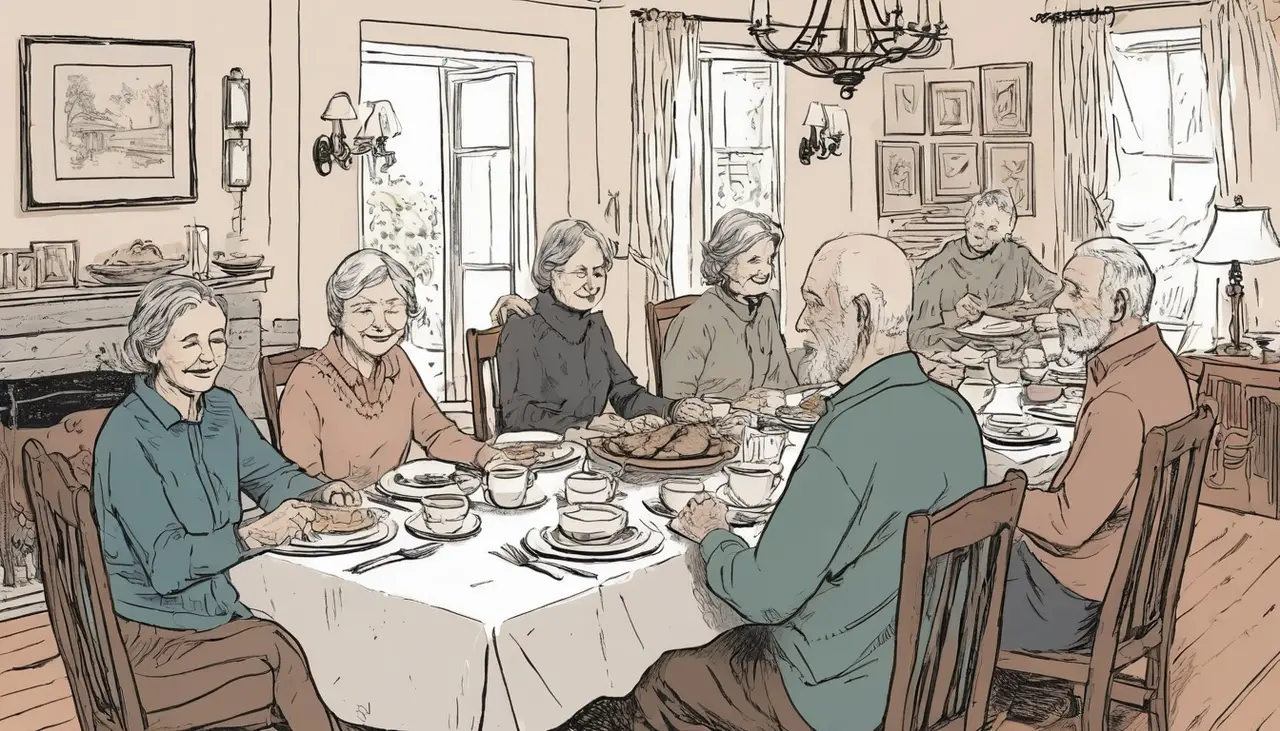
The glass is poured before you're through the door. Your uncle does it the way he's done it for twenty years — no question, just a full glass sliding toward your seat — and your mother is already watching to see what you'll do with it. You've been drinking less for three weeks. Nobody here knows that yet.
Somewhere between the salad and the second bottle, it will come. "Just one." "Since when are you no fun?" "Are you pregnant, or sick, or what?" You have reasons. A family dinner is the worst possible place to present them.
Start with a quieter definition of the job instead. A boundary isn't something you get your family to do — it's something you decide to do yourself, out loud, ahead of time. That one distinction does most of the work, and none of it requires anyone else to change. What you need is a plan small enough to carry in: call it the Kitchen-Table Boundary. Four moves — pick your line, say it short, give your hands a job, plan the door.
Why short answers beat good arguments
"You all need to stop offering me drinks" sounds like a boundary, but it's really a rule for other people, and rules for other people need their cooperation. "I'm not drinking tonight — and if it keeps coming up, I'll step outside for a while" is a boundary, because every part of it runs on you.
That difference matters more with family than with almost anyone else. A parent may hear your empty glass as a verdict on how they raised you. An in-law can take it as an insult to their hosting. A sibling pushes because pushing is the oldest game the two of you own. You can't script their reactions; you can control how much explaining you do — and explaining is where most boundary attempts die. A long, reasonable answer sounds like an opening bid. A short one ends the negotiation, because there's nothing in it to argue with.
If the harder conversation is with a partner, how to tell your partner you're cutting back covers that version; if it's what the kids are seeing, start with worried about drinking around your kids; and if the test runs a whole week instead of one dinner, a family trip where everyone else is drinking is that version.
Pick your line before you arrive
Make two decisions in the quiet before the event, not the noise during it. First: are you drinking tonight at all — and if so, what's your ceiling, as an actual number you can count? Counting is harder at family tables because home pours are generous. NIAAA defines a U.S. standard drink as 0.6 fluid ounces (about 14 grams) of pure alcohol, and your uncle's idea of one glass of wine can hold closer to two of those. For context, the Dietary Guidelines for Americans suggest adults who choose to drink keep it to two drinks or fewer a day for men, one or fewer for women — background for your own ceiling, not ammunition for an argument.
Second: your line. One sentence you can say in your sleep. "I'm taking a break." "I'm driving." "I feel better when I skip it at these dinners." "No thanks — tell me what's new with you."
Do it now: write one line in your phone. If it takes more than five seconds to say, it's an explanation, not a line.
Say it short, then say it again
When the line gets tested — and with family, it gets tested — repeat it with less detail, not more. The second "just one?" gets the same six words the first one did. That feels stiff, almost rude, and it's also the only answer that gives a pusher nothing to work with.
Two worries usually surface here. Do you have to tell them you're cutting back? No. "I'm driving" is honest and complete; you don't owe the table a medical history. And what if they hear judgment of their own drinking? Keep every word about you — "I feel better when I skip it" comments on nobody's glass but yours.
Do it now: pick the move that follows your line — a question back ("how's the new job?"), a topic change, a walk to the kitchen.
Give your hands a job
Pressure sticks to an empty hand. Get something nonalcoholic into yours in the first five minutes, because people mostly offer drinks to people who aren't holding one. Sit away from whoever refills without asking. If one relative is easy company, tell them the plan on the drive over — an ally who can pull you into a conversation is worth three prepared speeches.
There's a quieter reason for this move. Long family evenings let drinks accumulate without anyone deciding anything: a pour with dinner, a top-up during the story, another with dessert. NIAAA's binge-drinking threshold — a pattern that typically brings blood alcohol concentration to 0.08% or higher, often five or more drinks for men or four or more for women in about two hours — can arrive at a table like that one unmeasured top-up at a time.
Do it now: decide what will be in your hand for the first hour, and where you'll sit.
Plan the door
Choose your exit before you arrive: after dessert, at the kids' bedtime, when the second bottle opens. A cue you picked in advance turns leaving from a scene into a plan. And when words stop holding, the boundary becomes physical — refill your own glass with something else, move seats, step outside for air, leave earlier than usual. None of that requires an announcement. That's the point.
Do it now: name your cue, and tell the person you came with, so leaving is a team move rather than a defection.
When the line doesn't hold
Some night it won't. You'll say your line, take the glass anyway at ten o'clock, and drive home rehearsing the courtroom speech. Skip the trial. One rough dinner is information, not a verdict: what opened the door, what helped even a little, what would make the next dinner less dependent on mood? "The pressure got to me after the toast" is worth keeping. "I failed again" isn't. If the pushing turns into a genuine pull to drink, how to handle alcohol cravings and urges is that toolkit.
Measure the evening by the right yardstick. A boundary that annoyed your uncle still worked if you said what you planned to say and drank close to what you intended. Family approval is a nice bonus. It was never the goal.
Be honest about the harder cases as well: some relatives will not drop it, no matter how clean your line is. At that point the boundary stops being about phrasing and starts being about exposure — shorter visits, breakfast instead of dinner, seeing them somewhere alcohol isn't the centerpiece. Same principle, larger scale. Part of why family pressure cuts so deep is that these are the people who knew the old version of you — NIAAA names stigma as one of the most consistently reported barriers to getting help for alcohol concerns, and inside a family it often wears the costume of teasing.
If your own pattern is what worries you — drinking heavily most days, blowing past your ceiling again and again, a night without alcohol feeling physically hard — that's a clinician conversation, not a dinner-table one. If a stretch without drinking has ever brought on shaking, confusion, hallucinations, or a seizure, that's 911 or an emergency room, not a boundary problem. Short of that, if you don't have a clinician to start with — or you'd rather keep the family out of it — Clero connects you with a licensed clinician by telehealth to review your pattern and whether a medication like naltrexone fits a plan to drink less.
Most people never get that conversation at all. In 2024, per NIAAA, only about 7.6% of people with past-year alcohol use disorder received any alcohol treatment — a gap that says far more about who gets asked, and who feels able to ask, than about whether help works.
The next dinner
Back to the table, and the glass already sliding toward your seat. Next time you walk in, you won't be waiting to see whether the family behaves — you've stopped asking "how do I make them stop?" and started asking "what will I do when they don't?" That question has an answer now: a line, a repeat, a full hand, a door.
Before the next invitation lands, do the ten-minute version. Write the line. Choose the drink. Name the exit cue. Setting boundaries with family while you're cutting back on drinking rarely takes a dramatic announcement — a small plan, carried out quietly at a table full of people you love who may never fully get it, does most of the work. And that part is yours no matter what they do.
This article is general education — not medical advice, family therapy, or legal guidance. If you drink heavily every day, don't stop suddenly on your own; plan it with a clinician, because withdrawal can be dangerous. Shaking, confusion, hallucinations, or a seizure after cutting down means 911 or an emergency room now; if you feel unsafe with yourself, call or text 988; and SAMHSA's National Helpline at 1-800-662-HELP offers free, confidential treatment referrals around the clock.
- Alcohol Education
How to Handle Summer BBQs and Cookouts When You're Cutting Back
A cookout has no clock, so bring your own: pick your first drink, your spot, your line, and your exit before you go. Decide once, not forty times.
- Alcohol Education
How to Handle a Family Vacation When Everyone Drinks
The Morning-First Plan: decide the morning you want, protect the first group meal, and keep one non-negotiable exit from the nightly drift. No family vote needed.
- Alcohol Education
Drinking at a Wake or Funeral When You're Cutting Back
You can decline the drink and still be there for the goodbye. How to handle the glass at the door, the toast, and the late-night kitchen while cutting back.
- Alcohol Education
When a Friend Quietly Stops Drinking Too While You're Cutting Back
You don't have to say anything when a friend quietly stops drinking too — their reason is theirs. What one neutral sentence offers, and how their example helps.
- Alcohol Education
When Coworkers Notice You're Not Drinking at the Office
A short, prewritten line — 'Not tonight, early morning' — closes the question fast. What to say to peers vs. managers, and why ordering your drink first helps.
- Alcohol Education
How to Set Realistic Goals When Cutting Back on Drinking
A realistic cutback goal is one countable line for one week — not "drink less" forever. Count last week, set a modest cap, and plan the hardest night first.


Be the first to hear when Clero launches.
Join with email only. Clero is still in development, so this is educational content today — not treatment, a prescription request, or medical advice.
First to hear at launchLaunch news only — no spamUnsubscribe anytime