
When Your Parent Drinks More Than You and You're Cutting Back
Your risk follows your own pattern, not your rank at the family table — cutting back first isn't a betrayal. What to say once, and what's actually yours to change.
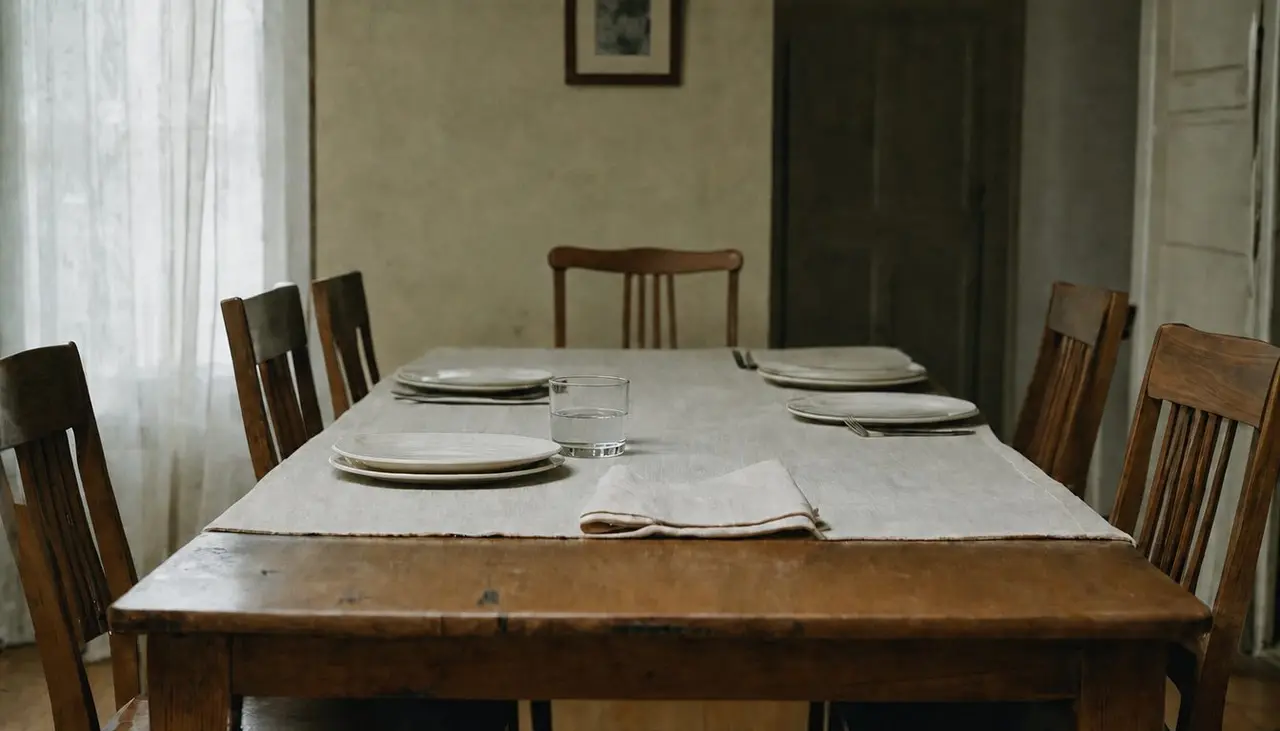
The bottle makes its way around the table and stops at your glass, which is still two-thirds full. Your father tops it off anyway — one practiced turn of the wrist, finished before your hand can reach the rim. He does it the way he passes the salt, without looking, mid-sentence. No one else notices. The glass sits there heavier now, and you are the only person in the room who knows how carefully you had planned to make it last.
You did say it, a few weeks ago, lightly, the way you might mention a new commute: you're cutting back. Either no one heard you or everyone did; it is genuinely hard to know which would explain tonight better. In this kitchen, drinks appear. They have always appeared. The pour is not a question here — it is hospitality, and it is his.
So the arithmetic of the evening is strange. You are the one drinking less. Your parent is the one drinking more — more than you, likely more than anyone at the table will say out loud — and somehow the change under review is yours.
For most of a life, the roles ran the other way. A parent is supposed to be the fixed point, the standard you calibrate against, and some part of you kept using that standard long after you stopped believing in it. The loud question shows up fast: if they drink more than I do, why am I the one changing? Hold it a while and a quieter question surfaces underneath. Whose measure have I been using?
Because in a house like that one, the unit of measure was never a number. It was his pour. NIAAA defines a U.S. standard drink as 0.6 fluid ounces of pure alcohol — 14 grams — and almost no home pour respects it; a generous hand can put a glass well past one standard drink without anyone counting anything. Grow up where the heaviest glass at the table set the baseline, and "not that much" gets defined by comparison to it. Cutting back means switching units. That is harder than it sounds, and it is part of why the topped-off glass can feel less like generosity and more like the old measuring system reasserting itself.
It helps, a little, to know how ordinary the raw material is. In NIAAA's summary of 2024 national survey data, about 174.4 million U.S. adults — roughly 66.5 percent — drank alcohol in the past year, while a much smaller group, about 14.4 million adults, or 5.5 percent, reported heavy alcohol use in the past month. A family where everyone drinks is the national default. A household where one person drinks heavily is common enough to be no one's private shame, and uncommon enough that noticing it does not make you dramatic.
The refill is only the first pattern. The second is the joke. "Too good for us now?" — delivered with a grin, timed for the audience of the table. It may be a defense, or a habit, or plain discomfort with change; whichever it is, it lands the same, and you laugh because laughing is cheaper than the conversation underneath it.
The third pattern is the one that runs in your head on the drive home: the comparison. They drink more than I ever did. Why am I the one doing the work? Fair question. It also quietly assumes the drinking in that house is a contest with one scoreboard, and that your effort only counts if it shames someone else's total. It does not work that way in either direction. Your risk follows your own pattern — how much, how often, for how long — not your rank in the family standings. The thresholds that matter are absolute, not relative: NIAAA's binge-drinking definition — a pattern that typically brings blood alcohol concentration to about 0.08 percent or higher, usually five or more drinks for a man or four or more for a woman within about two hours — never asks what anyone else at the table had. Being the lighter drinker at your parent's table is not the same thing as being fine, and being the first one to change is not a betrayal of anyone.
And underneath all three patterns, for a lot of people, is grief — the slow, unglamorous kind that comes from noticing that the person who was supposed to be your fixed point is the one drifting. There are more people carrying this than the silence suggests. In a 2023 federal analysis, NIAAA estimated that about 19 million U.S. children were living with at least one parent who met the criteria for a substance use disorder — and that those disorders were primarily alcohol, affecting over 12 million children. Those children become adults. Many of them end up at a table like yours, drinking less than the person who taught them what a pour looks like.
Part of why it all stays unspoken is stigma, which works inside families earlier and more thoroughly than it works anywhere else. NIAAA describes stigma as one of the most consistently reported barriers to getting help with alcohol; around a kitchen table it does its work a step sooner, stopping the sentence before it forms. You feel it every time the true observation gets swallowed and the joke gets laughed at instead.
Which raises the question you have probably typed into a search bar at midnight: should you say something to them?
There is no clean rule, and both ditches are real. You are allowed to say what you see — once, plainly, without a verdict attached. "I've noticed how much you're drinking, and I worry about you" is an observation and an offer, not a diagnosis, and it does not commit you to a campaign. What you cannot do is run their change for them. Their motivation, their health picture, whether their pattern amounts to a disorder — those belong to them and to a clinician who actually examines them, not to you by force of worry. Some parents hear the sentence and something shifts years later. Some never do. Saying it once and then stepping back is not giving up; it is the honest size of your role.
The part that is yours is smaller and more concrete. Your glass. Your hand over the rim. How long you stay — leaving before the late rounds start is a boundary that requires no announcement. Which topics you will not litigate at dinner. None of these are speeches. Most of them are barely visible. That is what makes them workable.
If a visit to that house reliably makes your own urge to drink louder, that is a pattern worth planning for, and how to handle alcohol cravings and urges is a fuller toolkit for those hours. And if the quieter worry is that your own drinking runs heavier than the family comparison lets you admit — the lighter-drinker-at-the-table math hiding a pattern that is real on its own terms — that question deserves an actual clinician, not another season of private accounting. If you do not have one to bring it to, Clero connects you with a licensed clinician by telehealth who can look at your pattern with you and talk through whether treatment, including medication, makes sense.
One safety line is separate from all of this and non-negotiable. If you drink heavily every day, do not stop suddenly on your own — a body used to daily alcohol needs the change planned with a clinician — and if cutting down brings shaking, confusion, hallucinations, or a seizure, call 911 or go to an emergency room.
Back at the table, nothing dramatic happens. The bottle comes around again and this time your hand gets to the rim first, and your father shrugs and moves on mid-story, and the moment you braced for turns out to be four seconds long. He drinks what he drinks. You drink what you decided to drink. The old agreement — his pour as everyone's unit — is still in force on his side of the table, and it has quietly expired on yours.
You do not have to renegotiate his terms. You already renegotiated the only ones that were yours to sign. When you leave, the glass he filled is still sitting there, mostly full, catching the kitchen light. Not a statement. Not a verdict on him. Just the first measurement taken in your own units, left where he can see it or not.
This essay is education and company, not medical advice, and it diagnoses no one — not you, not your parent. If what this family carries ever tips into hopelessness or thoughts of harming yourself, call or text the 988 Suicide and Crisis Lifeline; for everything quieter, a licensed clinician is the right reader for your particular story.
- Social events & holidays
How to Handle a Baseball Game or Stadium Event While Cutting Back
At a ballgame, set your number before the first pitch and count the 24-ounce souvenir cup as two drinks, not one. A plan that runs on the game's own rhythm.
- Social events & holidays
How to Handle a Concert or Music Festival When You're Cutting Back
At a concert or festival, the drinking happens in the gaps: set changes and bar lines, not the music. Plan the set breaks and the day stays yours.
- Social events & holidays
How to Handle Halloween When You're Cutting Back on Drinking
Halloween gets easier when you decide the cup, the shot answer, and the exit before the night starts moving.
- Social events & holidays
How to Handle Pride Events When You're Cutting Back on Drinking
A practical Pride Month pacing guide for brunches, parades, block parties, clubs, and house gatherings when you want the day to include less alcohol.
- Social events & holidays
How to Handle Thanksgiving When You're Cutting Back on Drinking
Thanksgiving is an all-day drinking cue: plan the timeline, family lines, and first sober holiday pressure before the table fills.
- Helping someone who drinks
When Your Partner Promises to Get Help but Keeps Drinking
A promise lives in someday; a plan lives on a Thursday. What to ask for instead of sincerity, and the boundaries you can keep on your own authority.


Be the first to hear when Clero launches.
Join with email only. Clero is still in development, so this is educational content today — not treatment, a prescription request, or medical advice.
First to hear at launchLaunch news only — no spamUnsubscribe anytime