
How to Handle Pride Events When You're Cutting Back on Drinking
A practical Pride Month pacing guide for brunches, parades, block parties, clubs, and house gatherings when you want the day to include less alcohol.
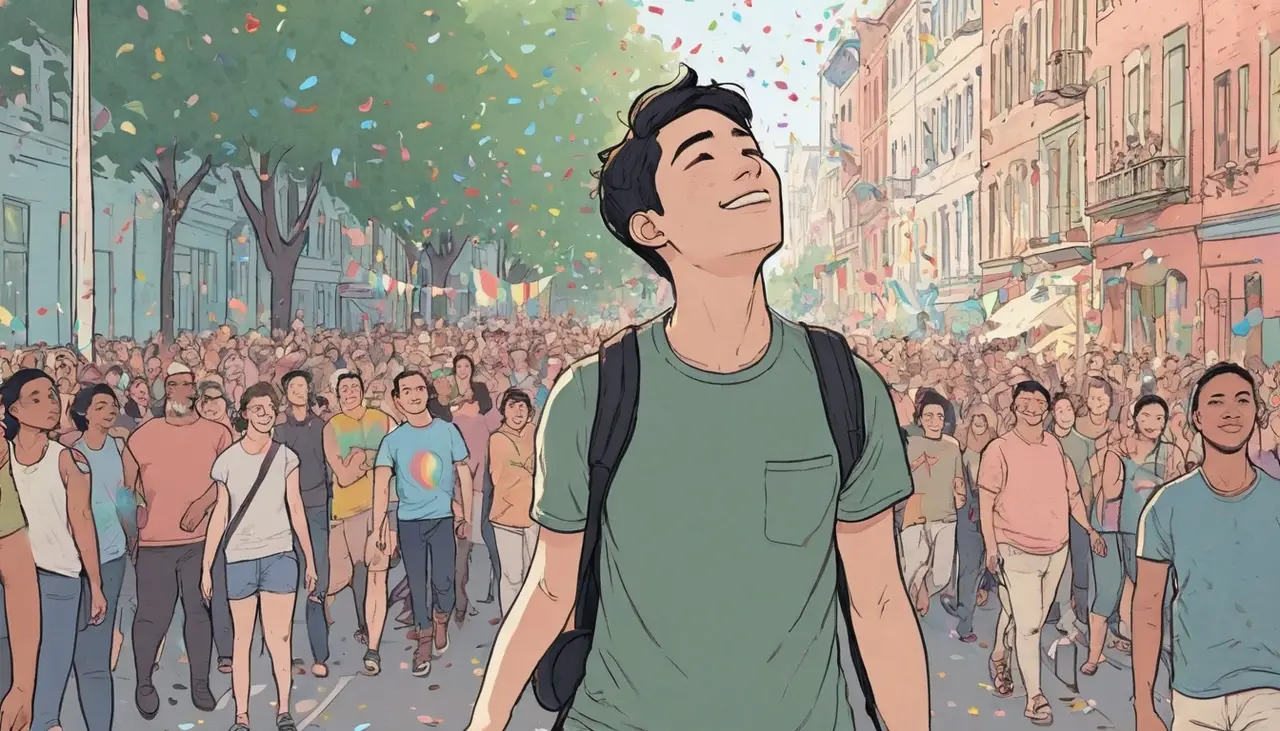
It's noon and you've already got a mimosa in your hand you didn't quite order. The brunch table refills itself. Outside, the parade hasn't even started, and someone is pressing a cup into your palm because that's what the day does — it hands you things. You wanted to be here. You also wanted to leave lighter than usual. Both of those can still be true.
Here's the thing nobody says out loud about a day like this: the pressure isn't really coming from you, and it isn't a sign you can't handle a celebration. It's the format. Pride packs brunch, a parade, a street fair, a house gathering, and a dance floor into one long stretch, and each one is built to keep a drink moving. So instead of white-knuckling your willpower across twelve hours, you're going to run the day like a set of stations — the Station Pass. Each part of the day is a station with its own pull, and you decide how you move through each one before you get there. You wouldn't try to sprint a whole marathon; you pace it by mile. Same idea.
Why the day pulls harder than a normal Saturday
A regular Saturday night is one setting. You arrive, you're there, you go home. Pride is five settings stitched together, and the drink follows you across all of them. Brunch starts it early. The parade keeps a cup in your hand while you walk. The street fair stretches the afternoon in the sun. The house gathering refills the glass once the public part winds down. The dance floor runs it into the night.
None of those individually looks like a heavy night. Added up, they can quietly land somewhere else. If you're counting, count real servings, not cups held — a crowded-event pour or a party refill is often more than one. NIAAA counts a U.S. standard drink as 0.6 fluid ounces, or 14 grams, of pure alcohol, and it flags binge drinking as the pattern that pushes blood alcohol to about 0.08% — often 5 or more drinks for men, or 4 or more for women, in roughly two hours. A full Pride day can drift into that range without ever feeling like a blowout. Not because you failed. Because nobody hands you a tally as you go.
The move is to stop treating the day as one endurance test and start treating it as stations you pass through on your own terms.
The Station Pass
Five stations, five decisions. Make each decision before you're standing in it, when the day is still quiet enough to think.
Pick your stations
You don't have to hit every stop. That's the first and biggest lever. Brunch, parade, block party, house, club — decide which two or three actually matter to you and let the rest be optional. A day still counts if you skip the bottomless brunch and show up for the parade. Do this now: name the one station you'd be sad to miss, and the one you could take or leave.
Set your number at the gate
Before the first plan starts, decide your count for the day. It can be zero, one, a hard cap, or a rule like "one drink per station, water in between." The number itself matters less than choosing it while you're clear-headed — because if you don't, the day picks for you, one reflex refill at a time. Do this now: say the number out loud to yourself, or text it to a friend so it's real.
Name the bottomless trap
Bottomless brunch is the sneakiest station, because the refill arrives before you decide you want it. That's structural, not a test of your resolve. You can order one drink and then let every refill after it be water, coffee, or a soda — the format assumes you'll keep going, so you just take the wheel back. Do this now: if brunch is on your list, decide your refill rule before you sit down.
Tell one person you're pacing
You don't need a speech or a confession. One friend who knows "I'm pacing today" can head off the third drink that would've landed in your hand by reflex. It also gives you an ally instead of a running negotiation with the whole table. Do this now: pick the person and tell them early, before anyone's counting.
Keep a clean exit line ready
Movement is your best escape hatch, and it works at every station. "I'm going to walk for a bit," "I'm grabbing water," "I want to catch the next block" — none of it requires explaining yourself. You're not quitting the day; you're stepping to the next station on your schedule instead of the drink's. Do this now: pick one line you'd actually say and keep it in your back pocket.
Two anchors run underneath all five: food and water. Not as moral props — because the day is long and hot and you're on your feet. For context, the 2020–2025 Dietary Guidelines for Americans suggest adults of legal drinking age who choose to drink keep it to 2 drinks or fewer in a day for men and 1 or fewer for women. That's public-health background, not a rule for how you do Pride — but it's a useful yardstick when you're setting your number at the gate.
When a station doesn't go to plan
Say brunch got away from you. The bottomless part did its job and you're three in before the parade starts. That is not the day's verdict.
The whole point of running it as stations is that each one resets. One station going sideways doesn't obligate the next four to follow. Eat something, drink water, let the buzz settle, and walk into the next station with a fresh number. The reflex is to think you've blown it so you might as well let the rest go — that's the sunk-cost trap, and it's wrong. The next station is a clean start, always.
And if you notice the pressure isn't really about the day at all — if you drink daily and the thought of cutting back feels less like pacing and more like something you can't do safely — that's worth taking seriously. Stopping suddenly after heavy daily drinking can be genuinely dangerous, so that's a conversation to have with a clinician who can help you plan it, not something to attempt alone in the middle of a party weekend.
What a lighter Pride actually tells you
Run the Station Pass once and you learn something you can't learn any other way: which part of the day you were actually there for. Maybe it was the parade, or your friends, or the music, or just being visible among your people. Often the drinking turns out to have been the format the day came in, not the thing you loved about it.
You'll also learn where your pressure lives. Maybe brunch was the hard station and everything after was easy. Maybe the public part was fine and the house gathering was where the plan slipped. That's not a performance review — it's a map for next time. Some people find that one lighter Pride makes the next one feel obvious to plan.
Stigma can make any of this harder to talk about, especially when you don't want the day to become about your drinking. NIAAA names stigma as one of the most consistently reported barriers to getting help for alcohol concerns — the embarrassment, the sense you should handle it alone. Naming that it's the barrier, not you, is often the first useful move.
So before the next event, do the smallest version of this: write down your two or three stations, your number, and your exit line. That's the whole Station Pass, and it fits on the back of a receipt. The day is still yours to enjoy — you're just walking through it at your pace instead of the drink's.
For more on the surrounding stretch, see how to socialize without drinking at summer events, how to handle a day-drinking event when you want to cut back, and how to handle FOMO when you are cutting back on drinking. If dating is part of the weekend, cutting back on drinking while dating may help; if people keep pushing drinks, how to handle friends who keep offering you drinks; and if a craving hits mid-celebration, how to handle alcohol cravings and urges is the full toolkit.
This is general education, not medical advice. If your drinking is heavy or daily, or stopping feels unsafe, talk with a licensed clinician before making changes — and for free, confidential 24/7 support and referrals, the SAMHSA National Helpline is at 1-800-662-HELP (4357).
- Social events & holidays
How to Handle FOMO When You're Cutting Back on Drinking
FOMO is rarely the whole night — it is the people, the place, the drink, or the feeling. Name which corner is hot, give it one small move, and set the phone down.
- Social events & holidays
How to Handle Thanksgiving When You're Cutting Back on Drinking
Thanksgiving is an all-day drinking cue: plan the timeline, family lines, and first sober holiday pressure before the table fills.
- Cutting back & moderation
What Is Mindful Drinking? The Practice Behind the Buzzword, Explained
Mindful drinking means deciding when, why, and how much you drink before the room decides for you. The three parts, five concrete moves, and who it fits.
- Social events & holidays
How to Handle Summer BBQs and Cookouts When You're Cutting Back
A cookout has no clock, so bring your own: pick your first drink, your spot, your line, and your exit before you go. Decide once, not forty times.
- Medication & treatment
How to Drink Less Without AA: A Practical Cutback Framework for People Who Aren't Doing a Program
Drinking less without AA works best as four weekly jobs: measure honestly, plan a number, prepare for the hard moment, and check in.
- Family & relationships
How to Handle a Family Vacation When Everyone Drinks
The Morning-First Plan: decide the morning you want, protect the first group meal, and keep one non-negotiable exit from the nightly drift. No family vote needed.


Be the first to hear when Clero launches.
Join with email only. Clero is still in development, so this is educational content today — not treatment, a prescription request, or medical advice.
First to hear at launchLaunch news only — no spamUnsubscribe anytime