
How to Build an Evening Routine Without Alcohol
To build an evening routine without alcohol, replace the drink's real job: marking the switch from work to rest. Four moves you can run tonight.
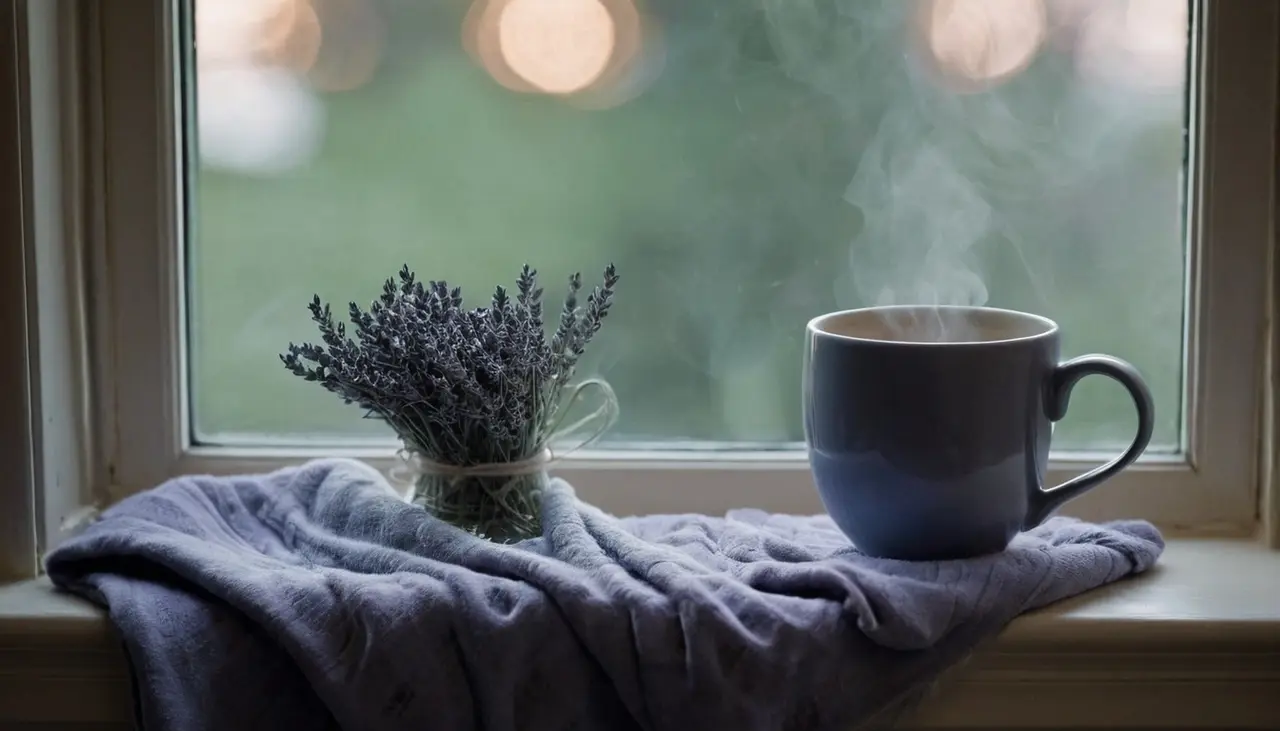
It is a little after six. The work is done, or done enough. You are standing in the kitchen with the day still humming in your ears, and before you have decided anything, your hand is already reaching for the bottle by the stove. The pour happens on its own. So does the one with dinner, and the one after, and the small last one that is really just a way of saying the day is allowed to end.
Here is the thing nobody tells you about that pattern: the drink is not the point. The handoff is. Every evening is a shift change — the working, output-producing part of you clocking out, the resting part of you clocking in — and alcohol has quietly become the whistle that blows to mark it. Take away the whistle and the two shifts don't know when to swap. That is the actual problem to solve. Not willpower. Not wine. The unmarked gap between doing and resting.
So this is a walkthrough for building what we will call the Handoff — a short, deliberate ritual that does the job the drink was doing, minus the drink. It is not a personality transplant. It is four moves, and you can run all four tonight.
Why the evening is where it lands
Notice that you probably aren't craving alcohol at nine in the morning. The pull shows up in a specific window, and almost always around a transition: work ending, the kids going down, dinner starting, the house going quiet. Transitions are uncomfortable in a small, hard-to-name way. Your brain is looking for a signal that it is safe to downshift, and a drink is a fast, reliable one.
That is a learned loop, not a character flaw — a cue (the quiet, the kitchen, the couch) that triggers a routine (the pour) that delivers a reward (the shift finally happens). Loops like this run on autopilot precisely because they work. The good news hiding in that is simple: a loop that was learned can be re-pointed. You keep the cue and the reward. You swap the middle.
One more thing worth knowing before the moves: a craving is not a rising line that climbs forever until you cave. It tends to crest and then fall, usually within minutes, whether or not you drink. You are almost never as far from the other side as it feels in the moment.
Move one: pick your seam
Your evening is not one long block. It is a series of seams — the places where one thing ends and the next begins — and the drink slots into one of them more than the others. Find that seam first, because it is where the whole Handoff will live.
For a lot of people it is the cooking seam: the first pour goes in while the onions do. For others it is the sit-down seam, the moment you finally land on the couch. For some it is the very end, the nightcap that closes the loop. Do not try to fix all of them. Pick the one where the drink starts itself without your say-so.
Do it now: think back over the last three evenings and name the single moment the first drink usually appears. That moment is your seam. Everything below plugs into it.
Move two: give the seam a job
An empty seam fills itself with the old routine. A seam with a job assigned does not. So before you get there, decide what the seam is for.
The job can be almost anything with a shape to it — a ten-minute walk the second dinner is over, a real drink you actually like in the glass you always used, one podcast episode while you cook, a single small task with a clear end. The content matters less than the fact that the space is spoken for. You are not trying to be productive. You are trying to leave less blank room where autopilot takes the wheel.
Do it now: assign one job to your seam for tonight. Write it as a sentence — "when dinner is done, I put shoes on and walk to the corner and back" — specific enough that future-you doesn't have to negotiate.
Move three: buy ten minutes at the pour
Here is the move for when the urge arrives anyway, mid-seam, sharp. You do not have to defeat it. You have to outlast it — and since it crests and fades on its own, you mostly just have to be somewhere else while it does.
So put ten minutes between the cue and the pour. Pour something else first and drink that. Step outside. Start the job from move two early. The urge does not need to be argued with; it needs to be given a few minutes to do what urges do, which is pass. If after ten minutes you still want the drink, that is information too — but you will have broken the automatic part, which is most of the battle.
Do it now: decide your ten-minute filler in advance, before you need it. Cold water, a walk to the mailbox, a phone call queued up. Pre-deciding is the whole trick; nobody invents a good detour while the craving is talking.
Move four: mark the shift on purpose
The reason the drink was so sticky is that it did the marking for you — it said, clearly, off duty now. If you pull it out and put nothing in its place, the evening can feel oddly unfinished, and that unfinished feeling is what sends you back to the bottle at ten p.m.
So name a real endpoint and a real signal. A screen-off time. A specific chair for the last hour. A cup of something warm you only have at night. Anything that tells your nervous system the shift is complete and it is allowed to stand down. This matters more than it sounds, because alcohol was never a good closer anyway — it fragments sleep and lightens its deepest stages even when it knocks you out at first, as the sleep research on drinking and rest describes. A cleaner shutdown tends to give you back a truer one.
Do it now: set tonight's stop signal. One line: "screens off at ten, tea, done."
When a move doesn't work
One rough evening is not a verdict on the whole thing. You will have nights where you run all four moves and still pour the old drink, and nights where you forget the moves entirely until you are already two in. That is not the Handoff failing. That is the first week of any re-learned loop, which wobbles before it holds.
The useful response is small: notice which seam gave way, and treat it as data for tomorrow rather than a scorecard for your character. If you want to compare the plan against something concrete, it can help to count what actually gets poured — NIAAA counts a U.S. standard drink as 0.6 fluid ounces, or 14 grams, of pure alcohol, so "two glasses" and "two standard drinks" are not always the same thing. Numbers turn a vague sense of how it went into something you can actually work with.
There is also a line where this stops being a routine problem and becomes a bigger one. NIAAA describes binge drinking as the pattern that brings blood alcohol to about 0.08% — often five or more drinks for men, or four or more for women, in roughly two hours. If your evenings routinely land there, a new podcast for the cooking seam is not the right-sized tool, and it is worth saying so plainly rather than tinkering with the ritual.
The one you carry out
Strip everything else away and the Handoff is a single idea: the evening is a shift change, and it goes better when you mark it on purpose instead of letting a drink mark it for you. Find the seam. Give it a job. Buy ten minutes when the urge spikes. Name a real endpoint. Run it for seven evenings before you decide anything about how it is going — one week is enough to see which seam is actually the hard one, and that alone is worth the experiment. For the nights a craving cuts straight through the ritual anyway, how to handle alcohol cravings and urges is the fuller toolkit.
This is general education, not medical advice. If you drink heavily every day, stopping suddenly can be genuinely dangerous, so plan any change with a licensed clinician first — and if a stretch without alcohol has ever brought on shaking, sweating, confusion, or a seizure, treat it as an emergency and call 911. To talk it through or find local support, the SAMHSA National Helpline (1-800-662-HELP) is free, confidential, and open 24/7.
- Alcohol Education
Drinking When You Can't Fall Asleep Without It
Can't fall asleep without a drink? Alcohol speeds you under but fragments the night. How to swap the nightcap cue for a new signal that the day is done.
- Alcohol Education
Excuses Not to Drink: What to Say When You Don't Want a Drink Tonight
"Not tonight, thanks" beats any elaborate excuse — short, boring lines end the drink offer cleanly. Ready lines for work events, dates, and the friend who pushes.
- Alcohol Education
Going Home When Old Friends Still Want to Drink
Going home to friends who still drink runs on an old script — but you can step off it without a speech. Five moves for the first night, from arrival to early exit.
- Alcohol Education
How to Be Confident Without Alcohol: Building the Real Thing
Confidence without alcohol is built from evidence — small sober reps your brain can't argue with. How to stack proof at events that used to require a drink.
- Alcohol Education
How to Handle a Work Cookout or Pool Party When You're Cutting Back
At a work cookout, most of the pressure comes from your empty hand. Fill it in the first two minutes and the offers stop finding an opening. Four ten-second moves.
- Alcohol Education
How to Compare Online Alcohol Support Without Getting Overpromised
To compare online alcohol support, look past the headline promise and check what support is included, who answers questions, how billing and cancellation work, what the privacy language says, and what the service does not claim to replace. A serious option should make its limits easy to understand.


Be the first to hear when Clero launches.
Join with email only. Clero is still in development, so this is educational content today — not treatment, a prescription request, or medical advice.
First to hear at launchLaunch news only — no spamUnsubscribe anytime