
Drinking When You Can't Fall Asleep Without It
Can't fall asleep without a drink? Alcohol speeds you under but fragments the night. How to swap the nightcap cue for a new signal that the day is done.
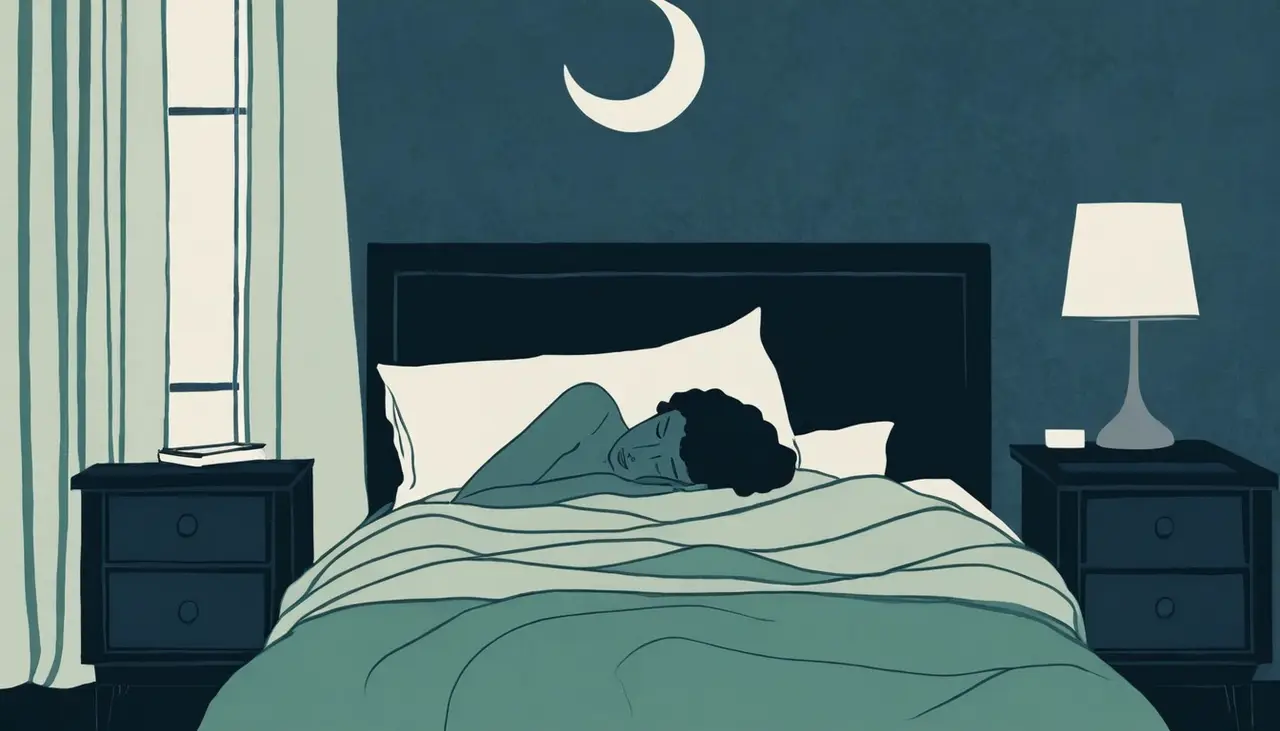
The lights are off. Your body did its part hours ago — heavy legs, gritty eyes, the day clearly over. But your mind hasn't gotten the message, and the one thing that used to flip the switch is the thing you're trying not to reach for. So you lie there. Negotiating.
That gap — tired but wired, with the old off-switch missing — is the whole problem. And it's workable. The way through is handing your brain a different signal that the day has closed. Call it the Last-Call Swap: you replace the cue, so there's no hole where it used to be. The wine was never really sleep. It was a closing bell. The work is finding a new bell your body will answer to.
One non-negotiable before the tool. If you drink heavily every day, do not stop suddenly on your own — talk with a licensed clinician first, because stopping all at once can tip your nervous system into dangerous withdrawal. MedlinePlus lists tremor or shakiness, sweating, rapid heart rate, hallucinations, seizures, and severe confusion as possible withdrawal symptoms, with seizures, severe confusion, or hallucinations warranting a call to 911 or a trip to the emergency room. The Last-Call Swap is for ordinary rough nights, not for managing that.
Why the bell stopped working
Here is the part worth understanding before you change anything. Alcohol feels like a sleep aid because it works fast on the front end — its sedative effect, the drowsy push you feel not long after a drink, speeds how quickly you fall asleep. That is the part you noticed and came to rely on. What you did not notice is the back end: the same drink leaves the rest of the night lighter and more fragmented, with more waking, so sleep quality drops even when the hours look the same.
Two more things compound it. First, the bell wears out. Tolerance to alcohol's sedative effect builds within three to seven days of regular use, which is why the nightcap that once knocked you out stops doing much — you need it and it barely works. Second, when you pull it away, your nervous system has been leaning on it. Picture your brain running on a brake and a gas pedal. Regular alcohol presses the brake — a calming chemical messenger called GABA — and eases off the gas, its revving counterpart, glutamate. The brain adapts by loosening the brake and leaning harder on the gas, so when the alcohol clears, those adjustments are left unopposed and tip into restlessness and insomnia. That rebound is the wired feeling at lights-out. It's real, it's chemistry, and it's not a character flaw. If the restlessness concentrates in your legs — a crawling, have-to-move feeling once you lie down — alcohol and restless legs takes up that specific version.
So the closing bell you are trying to replace was already a frayed, double-edged tool. Knowing that is the permission slip: you're retiring a sleep aid that had already worn out.
The Last-Call Swap
Four moves, in roughly this order. None of them is a sleep protocol. Each one is a way to hand your brain a new closing bell, or to keep the old one from ringing.
Ring a new bell
Pick one small, repeatable ritual to become the new "day is over" signal — a warm shower, dim lights, tea, a few pages of a book, light stretching. The specific thing matters less than the sameness. A cue earns its power by repetition, so run the same sequence most nights until your body reads it the way it once read the pour. Do it now: choose tonight's bell and set it somewhere you'll trip over it — the book on the pillow, the kettle pre-filled.
Move the old bell out of reach
Do not keep alcohol at the bedside, and shift the wind-down out of the room where you used to pour. A cue you can see is a cue that keeps ringing. You're aiming to remove the moment of wanting from the room entirely. Do it now: walk the bottle to the farthest cabinet, and decide where the new wind-down happens instead.
Ride the bedtime wave
The pull at lights-out behaves like any craving — it rises, peaks, and falls if you don't feed it. Tell yourself you can decide in fifteen minutes, then ride it out. NIAAA's strategies for handling urges — delay, distract, let it pass — work at bedtime too. Do it now: when the wanting spikes, name it ("this is the wave"), start a timer, and let the clock, not the bottle, win the argument.
Don't fight it in the bed
If you're still wired after about twenty minutes, get up. Keep the lights low, do something dull, and go back only when you feel sleepy. Losing the argument night after night in the same bed turns the bed itself into a stress cue — exactly what you don't want. Do it now: pick the dull thing in advance, so getting up doesn't become its own decision.
Steady the mornings while you're at it. A consistent wake time is one of the few levers that reliably helps the next night, even after a rough one — so pick one wake time, hold it, and don't let a bad night move it.
When the Swap doesn't land
One rough night is not the verdict on any of this. The first stretch can feel worse before it feels clearer, because the old bell is gone and your body needs time to learn the new one. Some people come out the other side noticing fewer 3am wakeups, less sweating, less next-day fog. Others find sleep stays broken and need more than a wind-down ritual.
Two honest checks. Ask how long alcohol has been the closing bell, and count what's actually in the glass when you answer — a U.S. standard drink is 0.6 fluid ounces, or 14 grams, of pure alcohol — because a two-week habit and a seven-year nightly pattern are not the same job. And ask whether the sleep itself is improving, holding flat, or getting worse. If falling asleep stays hard for two weeks or more, that's a conversation for a clinician. So is anything that looks like a breathing issue at night — gasping, choking, pauses, heavy snoring, daytime sleepiness — because alcohol relaxes the muscles that hold your airway open and can worsen sleep apnea, and that is not something a ritual fixes.
It is also worth knowing you are not an outlier here. Sleep trouble is one of the most common companions of heavier drinking, and the disturbances — longer to fall asleep, more night waking — often persist well into a cutback rather than clearing in the first month. If your nights stay hard, you're inside a known pattern. For scale: in 2024, an estimated 27.9 million people ages 12 and older, about 9.7 percent, had alcohol use disorder — a lot of company in the wired-at-midnight club.
What to carry out
The one idea worth keeping: the drink was a bell, not a sleep aid, and a bell can be replaced. You're building the new closing signal during the day, so midnight has less to argue about.
So tonight, pick one move. Usually the new ritual or moving the bottle out of reach. Try it for a few nights and write down what time you tried to sleep, what happened after the lights went off, and how much you'd been drinking, so you can actually see whether it's shifting. If heavy daily drinking is in the picture, start with a clinician — that's the withdrawal-safety rule from the top of this piece. And run one last honest check: if the nightcap has become load-bearing — if the day genuinely can't close without it — that's a physiology question for a professional, so ask one. Clero is how you ask without leaving the house: a confidential way to talk with a clinician who can look at the drinking itself, and at whether medication belongs in the plan.
The lights will go off again tonight. This time you've got a different bell to ring. For the moments the urge spikes hardest, keep how to handle alcohol cravings and urges within reach.
The Last-Call Swap is general education, not a treatment plan. If the drinking or the sleep has you worried, the next bell worth ringing is a licensed clinician who can look at the whole picture with you.
- Social events & holidays
Going Home When Old Friends Still Want to Drink
Going home to friends who still drink runs on an old script — but you can step off it without a speech. Five moves for the first night, from arrival to early exit.
- Understanding your drinking
I Drink Too Much but Not an Alcoholic
You can drink too much without accepting the label alcoholic — both can be true at once. How to look at the pattern instead of arguing with a word.
- Social events & holidays
Drinking at a Wake or Funeral When You're Cutting Back
You can decline the drink and still be there for the goodbye. How to handle the glass at the door, the toast, and the late-night kitchen while cutting back.
- Mind & mood
Grief and Alcohol: When a Drink Becomes How You Get Through the Loss
A drink can turn grief's volume down for an hour, but it usually hands the loss back heavier. Why the relief flips — and gentler ways through the worst evenings.
- Cutting back & moderation
How to Build an Evening Routine Without Alcohol
To build an evening routine without alcohol, replace the drink's real job: marking the switch from work to rest. Four moves you can run tonight.
- Cutting back & moderation
Drinking When You Haven't Told Anyone You're Cutting Back Yet
How to think through a private cutback before disclosure, including social scripts, clinician-first safety, and what privacy does not mean.


Be the first to hear when Clero launches.
Join with email only. Clero is still in development, so this is educational content today — not treatment, a prescription request, or medical advice.
First to hear at launchLaunch news only — no spamUnsubscribe anytime