
A 10-Minute Morning Routine To Ease Hangxiety Before Work
Hangxiety before work needs a fast shape: water and food, slow breathing, a small reset, and one plan for the first hour.
You wake up with the familiar mix: dry mouth, dread, a body that feels slightly over-caffeinated even before coffee, and a workday that is not going to wait for you to feel normal.
Do not try to solve your life in that state. Give the next ten minutes a shape.
The routine below is a ten-minute floor: steady the body, slow the alarm, interrupt the spiral, and choose the first hour of work. It will not erase hangxiety. It can make the morning less shapeless while the feeling passes.
Why the morning feels so charged
Hangxiety is not a formal diagnosis. It is the shorthand people use for anxiety, dread, guilt, and nervous-system static the morning after drinking.
Part of the charge comes from sleep. Alcohol can make sleep start faster, then disturb the architecture of the night after that. A review on disturbed sleep and alcohol use describes alcohol-related sleep disruption even when drinking initially seems to help someone fall asleep. So you may wake up with enough hours on paper but a body that did not get the kind of rest it needed. For the fuller why-explainer, see alcohol and anxiety the next day.
The other part is interpretation. The body feels off, then the mind starts explaining why: everyone noticed, the email will be impossible, the meeting will expose you, the day is ruined. Some of those thoughts may contain real information. Most are too loud for 7 a.m.
That is why the first move is physical. You are not debating the dread. You are giving it less room to run.
The ten-minute floor
Use the sequence as written once. After that, keep the pieces that work. The timing is not sacred; the order is the point.
Minutes 0-2: put fuel before analysis
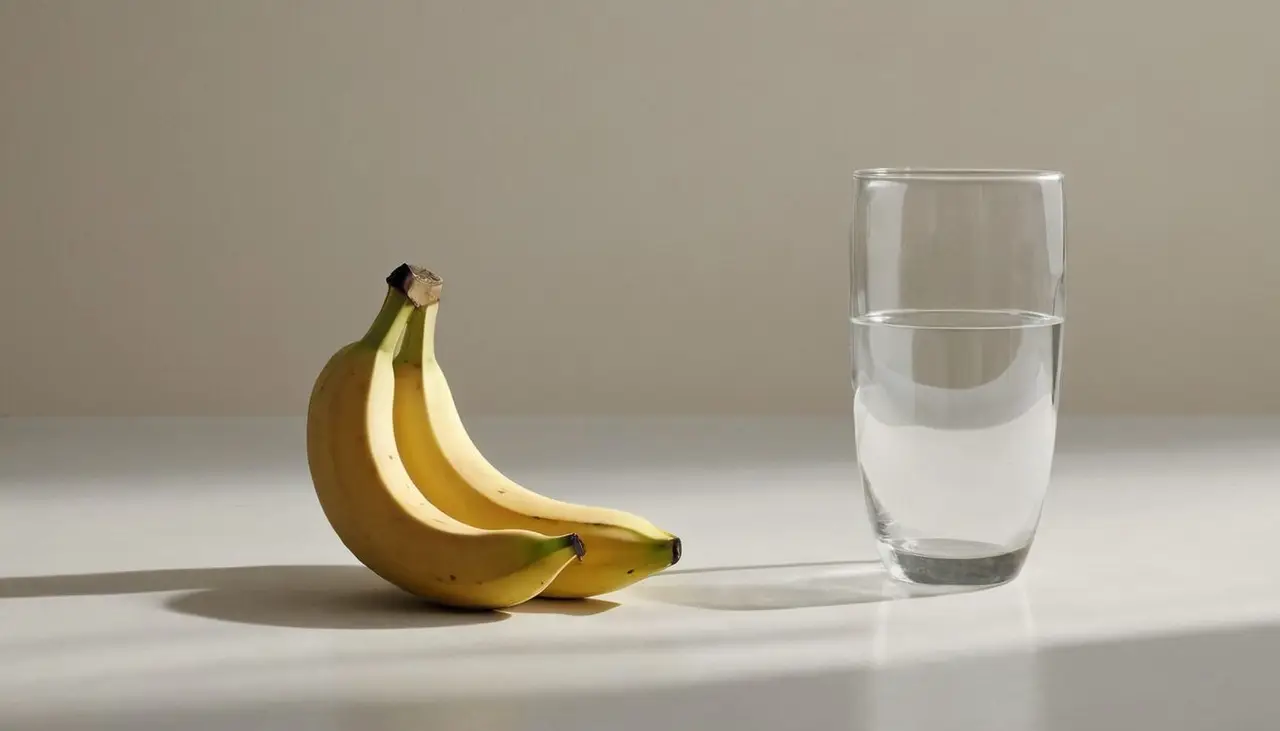
Drink water and eat something small before you start judging the day. Toast, yogurt, a banana, leftovers, whatever is available. You are not treating a condition or undoing the night. You are making sure hunger, thirst, and a rough night of sleep are not all masquerading as a single catastrophe.
Keep the action plain: water in hand, food in reach, feet on the floor. If coffee makes the jitters louder, delay it until after the first few minutes of food and water.
Minutes 2-5: slow the alarm
Set a timer for three minutes and breathe out longer than you breathe in. A simple pattern is enough: inhale gently, then exhale a little longer, again and again. You do not need perfect technique. You need a signal that the morning is not an emergency just because it feels like one.
When the thought loop barges in, label it without arguing: "work dread," "memory replay," "I feel exposed," "my body is loud." Labeling turns the noise into an object. Objects are easier to carry than weather.
Minutes 5-7: change one physical cue
Move the room. Open a curtain, rinse your face with cool water, step outside for thirty seconds, make the bed, or put on work clothes before you check messages. The move should be small enough that you will actually do it while anxious.
This is where the routine differs from a general morning craving plan. You are not building an ideal morning. You are getting a pre-work body out of the exact spot where the dread started.
Minutes 7-10: choose the first work hour
Pick the first hour, not the whole day. Choose one low-friction task, one message you can answer, or one meeting prep move. Write it as a sentence: "For the first hour, I will do ___ before I decide how the day is going."
That sentence matters because hangxiety loves global verdicts. It says the whole day is blown. You answer with a smaller frame: the first hour has a plan.
If you can, avoid opening every channel at once. Email, messages, calendar, and news can make the nervous system feel cross-examined. Start with the one tool needed for the first task.
If it lingers at your desk
Keep the frame narrow. Stand up once an hour. Eat something real if you skipped breakfast. Do one administrative task before a high-stakes one. Put shame-heavy thoughts into a note you will review later, not into a message you send now.
NIAAA's Rethinking Drinking describes urges as normal, often short-lived, and easier to handle when you recognize the trigger and have a coping response. That idea fits hangxiety too: the wave feels total while it is rising, then it changes. Your job is not to prove you are fine. It is to avoid making the morning bigger while the wave is still high.
One sentence can help: "I do not have to believe every thought I have before lunch."
The pattern is the part to notice
An occasional rough morning is information. A recurring pre-work hangxiety pattern is louder information.
If this keeps happening, do not use the routine as permission to repeat the same night. Use it as a bridge to a clearer look at the pattern: when you drink, how much, what kind of workday follows, whether anxiety was already there before the drinking, and whether the morning-after dread is starting to shape your job, relationships, or safety.
The treatment and recovery resource from the National Institute on Drug Abuse (NIDA) frames substance-use recovery as managing a chronic condition, not passing a one-time test. That matters because a rough stretch is not proof that you are hopeless. It is a reason to adjust the plan and bring in support if the same loop keeps repeating.
If you want a private external starting point for that pattern, Clero can be a quiet first place to take it outside your head: a telehealth clinician visit focused on what keeps repeating and what support, including medication when appropriate, is worth discussing.
When the routine is the wrong tool
Use care if the symptoms are not just anxiety. Chest pain, fainting, severe vomiting, severe confusion, trouble breathing, or symptoms that feel medically unsafe are not a "push through the workday" situation. Call a clinician, urgent care, or 911 depending on severity.
And if you drink heavily most days, do not use a morning routine as a withdrawal plan. Feeling shaky, sweaty, confused, or physically unwell when you go without alcohol can be a sign that stopping abruptly is medically risky - ask a clinician how to stop safely before you try, and treat confusion or a seizure as a 911 situation.
One glass of water tonight
Ten minutes will not fix the larger pattern. It is not supposed to.
It gives this morning a floor: water and food, three minutes of slower breathing, one physical reset, one first-hour plan. If the feeling passes, let it pass without making it the headline of the day. If it keeps returning morning after morning, let that be the signal to ask for more support.
Set a glass of water where you will see it tomorrow. That is enough of a first move.
This article is general education, not medical advice or a cure for anxiety. If symptoms feel medically unsafe, call urgent care or 911; if cutting back brings withdrawal symptoms, talk with a licensed clinician before stopping abruptly; SAMHSA's National Helpline is 1-800-662-HELP for treatment referrals; and if you feel unsafe with yourself, call or text 988.
- Social events & holidays
How to Handle a Baseball Game or Stadium Event While Cutting Back
At a ballgame, set your number before the first pitch and count the 24-ounce souvenir cup as two drinks, not one. A plan that runs on the game's own rhythm.
- Family & relationships
How to Handle a Family Vacation When Everyone Drinks
The Morning-First Plan: decide the morning you want, protect the first group meal, and keep one non-negotiable exit from the nightly drift. No family vote needed.
- Social events & holidays
Drinking on Vacation When You Are Trying to Cut Back
Vacation drinking spreads because the trip removes your routines — so build your own banks: a shape set before you pack, one alcohol-free hour a day, a reset plan.
- Social events & holidays
Drinking When Traveling for Work
Work trips attach a drink to every stop — gate, flight, hotel room, reception, dinner. Map the route before you pack and decide the hardest stop early.
- Cutting back & moderation
How to Set Realistic Goals When Cutting Back on Drinking
A realistic cutback goal is one countable line for one week — not "drink less" forever. Count last week, set a modest cap, and plan the hardest night first.
- Understanding your drinking
5 Strange Reasons You Drink Too Much
A myth-correcting look at why drinking too much is often driven by ordinary cues, permission moments, stress loops, and blind spots rather than one dramatic cause.


Be the first to hear when Clero launches.
Join with email only. Clero is still in development, so this is educational content today — not treatment, a prescription request, or medical advice.
First to hear at launchLaunch news only — no spamUnsubscribe anytime