
Drinking When Traveling for Work
Work trips attach a drink to every stop — gate, flight, hotel room, reception, dinner. Map the route before you pack and decide the hardest stop early.
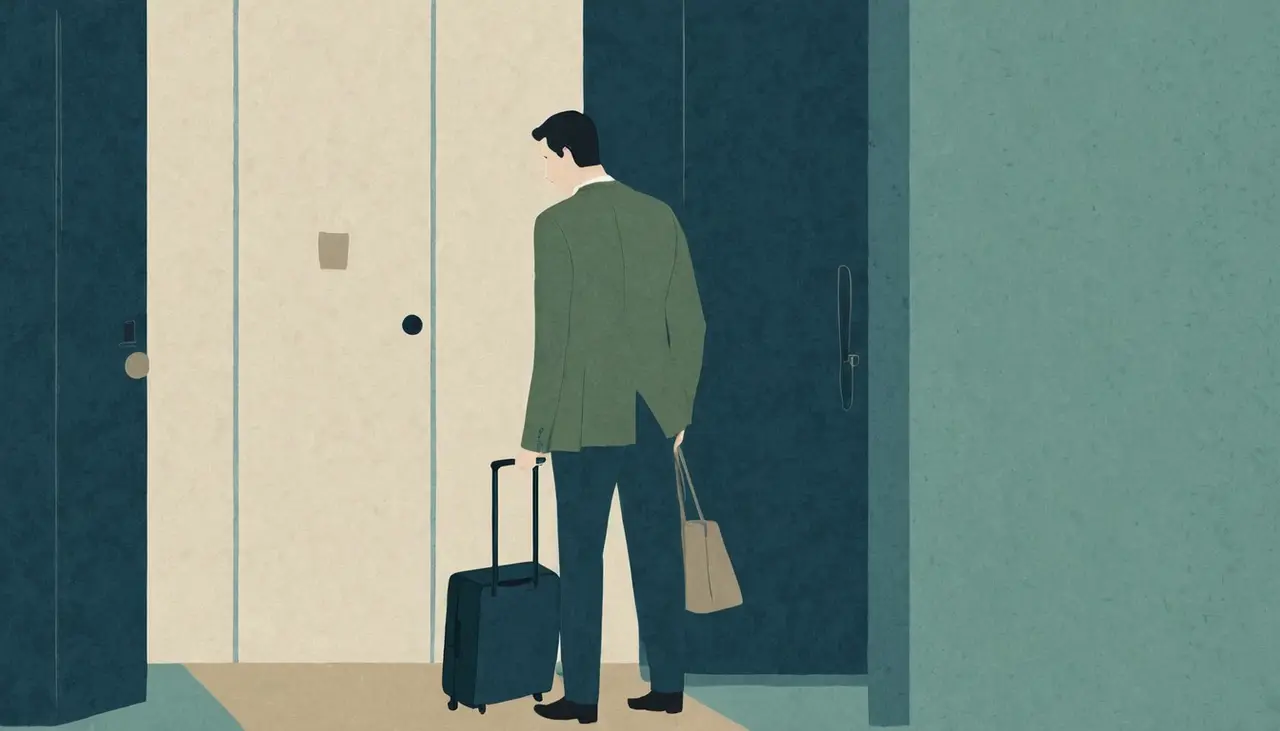
You are at the gate an hour early, roller bag parked against your shin, and the bar across the concourse has open stools and a screen showing something you half care about. Nobody is watching. The workday hasn't started and won't for two time zones. A drink here isn't a decision so much as a way to fill the gap the airport hands you.
Hold that moment, because it repeats. The gate, the seat, the room, the reception, the dinner, the bar after — a work trip isn't one choice about drinking. It's a route with predictable stops, and you can chart the route before you leave.
That's the whole trick here, and it's a mild relief once you see it: you don't have to become a more disciplined person on the road. You don't have to white-knuckle six separate temptations while jet-lagged and performing for coworkers. You have to do one small piece of planning at your kitchen table. Call it the trip map — you lay out the stops in advance, you find the one that does the most damage, and you decide that one stop before you're standing in it. The rest tends to take care of itself once the hardest turn is marked.
Why the trip stacks up the way it does
At home, drinking usually hangs off one hook — the couch after work, the Friday thing. Travel unhooks it and re-attaches it to every transition, and there are a lot of transitions in three days.
Waiting becomes a drink. The flight becomes a drink because it's offered and sometimes free, which makes it feel like part of the ticket rather than a choice. The empty hotel room becomes a drink because the day is over and no one is setting your pace. The reception becomes a drink because a glass gives your hands something to do in a loud room full of strangers. Dinner becomes wine for the table, poured without a fresh yes from you each time. The late bar becomes a drink because you're wired and want to come down.
None of those is dramatic on its own. The problem is the arithmetic. Line up the stops and a three-day trip can carry more alcohol than a lighter month at home — and it can slide into a genuine binge pattern without you ever deciding to have a big night. The CDC counts binge drinking as four or more drinks for women or five or more for men on a single occasion. A client dinner that starts with a cocktail and rolls into wine clears that bar easily, quietly, in the ordinary course of being polite. If you want a shared yardstick for comparing one trip to another, a U.S. standard drink is 0.6 ounces — 14 grams — of pure alcohol, per the CDC: a 12-ounce beer, a 5-ounce glass of wine, a 1.5-ounce shot. Those are just measuring units, not a line where harm switches on. How much a given trip costs you depends on how much you drink and across how many days, and it lands differently person to person — your size, your sleep, what you ate, what else you take, how your body handles alcohol. There's no single count that's safe for everyone or ruinous for everyone. The point of counting isn't a verdict; it's so "the trip felt heavy" turns into a number you can actually work with next time.
Mapping the trip before you pack
Here's the framework, four moves. Do the first three at home. The fourth is the only one that happens on the road, and it's short.
Draw the whole route
Before you pack, write the stops in order: gate, flight, hotel room, reception, dinner, late bar, next morning. Seeing them as a sequence instead of a fog is most of the work. A fog feels like one big test of character you'll either pass or fail. A list is just a list — six or seven ordinary moments, each of which you can look at plainly and ask, is this one actually hard for me, or am I drinking here out of habit?
Do it now: open your notes app and type the stops for your next trip, in order. Thirty seconds.
Mark the hardest stop
One of those stops is doing most of the damage, and it's usually not the one you'd guess. For some people it's the empty room, where a work-socializing pattern quietly becomes private drinking alone. For others it's the late bar, where the trip's real cost lands on the next morning. For others it's the client dinner, where the pour keeps topping up and no single glass ever feels like a decision.
Pick the one. You're not solving the whole trip. You're marking one turn on the map and giving it your attention, because attention spread evenly across six stops is attention spread thin.
Do it now: circle one stop. Just one.
Set the rule before you're standing in it
A rule you decide at your kitchen table beats a debate you have with yourself at 11 p.m. in a hotel lobby, tired and half-committed. So decide the hard stop's rule in advance, concretely.
If the room is your stop, the rule is physical: don't put alcohol in the room. Nothing poured from the minibar, nothing carried up from the lobby. If the dinner is your stop, decide your first line before you sit down, so the waiter's question doesn't catch you improvising. If the late bar is your stop, decide the exit before you walk in — one drink, or a short appearance and out. The rule works precisely because you're not negotiating it in the moment; you already did.
Do it now: write one sentence — the rule for your circled stop.
Carry two small lines
The map handles the planned stops. For the unplanned pressure — the coworker refilling your glass, the "come on, one more" — you want a couple of short lines ready, because scrambling for words is when people cave. Two cover almost everything. "I'm fine for now" holds at the table without ending anything. "I've got an early start" clears you out of the late bar, and it's true even if the early start is just your plan to wake up clear-headed. If someone pushes, you owe them nothing — "I'm pacing tonight" is a complete sentence. None of this requires announcing that you're cutting back or turning your drinking into the table's business.
Do it now: say both lines once, out loud, so they're in your mouth and not just your head.
The next morning is why the late-bar line earns its keep. Alcohol near bedtime speeds you to sleep and then wrecks the back half of the night — it fragments sleep and cuts its quality even when the total hours look normal, per a review in Current Opinion in Psychology. On a trip, that's the difference between walking into the 8 a.m. sharp and walking in scraped-out. The map isn't only about the drinking. It's about who shows up to the work.
When the map doesn't hold
Some trips go sideways anyway. The dinner runs long, the reception is worse than you planned for, and you drink more than the map said. This is worth saying plainly, because the alternative is quietly deciding the whole approach was pointless: one heavy night is not a verdict on you, and it doesn't erase the plan.
The map's real payoff isn't a perfect trip. It's information. A trip where you watched the stops — even if you didn't hold every one — tells you which stop actually runs you. Maybe the airport drink turned the entire travel day into a vacation in your head. Maybe the room alone was the one that mattered all along. Next trip, you don't start from fog. You start from the room is my stop, and the map gets shorter and sharper each time. If a trip goes fully off the rails and the week after feels shaky, how to restart cutting back after a vacation works the same for a work trip as a leisure one.
One more honest note about reputation, since travel drinking is often tangled up in it. NIAAA names stigma — the fear of how it looks — as one of the most consistently reported reasons people don't get help for alcohol. If part of what keeps the drinking in place on trips is not wanting colleagues to notice you've eased off, know that the eased-off version is almost always the one nobody remarks on. Pacing reads as normal. It's the other direction people remember.
The one thing to carry off the plane
Back to the gate, because that's where it starts. The next time you're parked at your stool an hour early, you don't need a rule for the airport unless the airport is your stop. You need to already know which stop is, and what you decided to do there. That's the whole map: one turn marked, one rule set, two lines ready. You built it at your kitchen table so you don't have to build it exhausted at a hotel bar.
For the single-dinner version of this, how to handle work dinners when you're cutting back goes deeper on that one stop. And for the moments a craving shows up somewhere you didn't plan for, how to handle alcohol cravings and urges is the fuller toolkit.
This is general education, not medical advice. If travel keeps pulling you past what you planned, if drinking is affecting your work or the people around you, or if stopping on your own feels out of reach, talk with a licensed clinician — or call SAMHSA's free, confidential helpline at 1-800-662-HELP (4357). If stopping after heavy daily drinking has ever brought on shaking, sweating, or confusion, treat that as a medical emergency and call 911.
- Quitting & sobriety
How do I stop drinking?
Stopping drinking starts with safety, not willpower. If you drink heavily every day or have had withdrawal symptoms, ask a clinician what level of care is safest before you stop suddenly. If you are medically stable, the next step is to choose support that matches your goal, privacy needs, and risk level: therapy, peer support, medication education, primary care, telehealth, outpatient treatment, or a higher level of care.
- Quitting & sobriety
The Dangers of Quitting Alcohol Cold Turkey
Quitting alcohol cold turkey can be dangerous for a heavy daily drinker. The withdrawal signs that need 911, and what to ask a clinician before you stop.
- Cutting back & moderation
What Is Mindful Drinking? The Practice Behind the Buzzword, Explained
Mindful drinking means deciding when, why, and how much you drink before the room decides for you. The three parts, five concrete moves, and who it fits.
- Social events & holidays
How to Handle Summer BBQs and Cookouts When You're Cutting Back
A cookout has no clock, so bring your own: pick your first drink, your spot, your line, and your exit before you go. Decide once, not forty times.
- Mind & mood
A 10-Minute Morning Routine To Ease Hangxiety Before Work
Hangxiety before work needs a fast shape: water and food, slow breathing, a small reset, and one plan for the first hour.
- Body & physical health
Drinking When You Can't Fall Asleep Without It
Can't fall asleep without a drink? Alcohol speeds you under but fragments the night. How to swap the nightcap cue for a new signal that the day is done.


Be the first to hear when Clero launches.
Join with email only. Clero is still in development, so this is educational content today — not treatment, a prescription request, or medical advice.
First to hear at launchLaunch news only — no spamUnsubscribe anytime