
How Can I Drink Less When I Am Stressed?
A moderation-valid Q&A for people who want to drink less during stressful weeks without committing to a new identity.
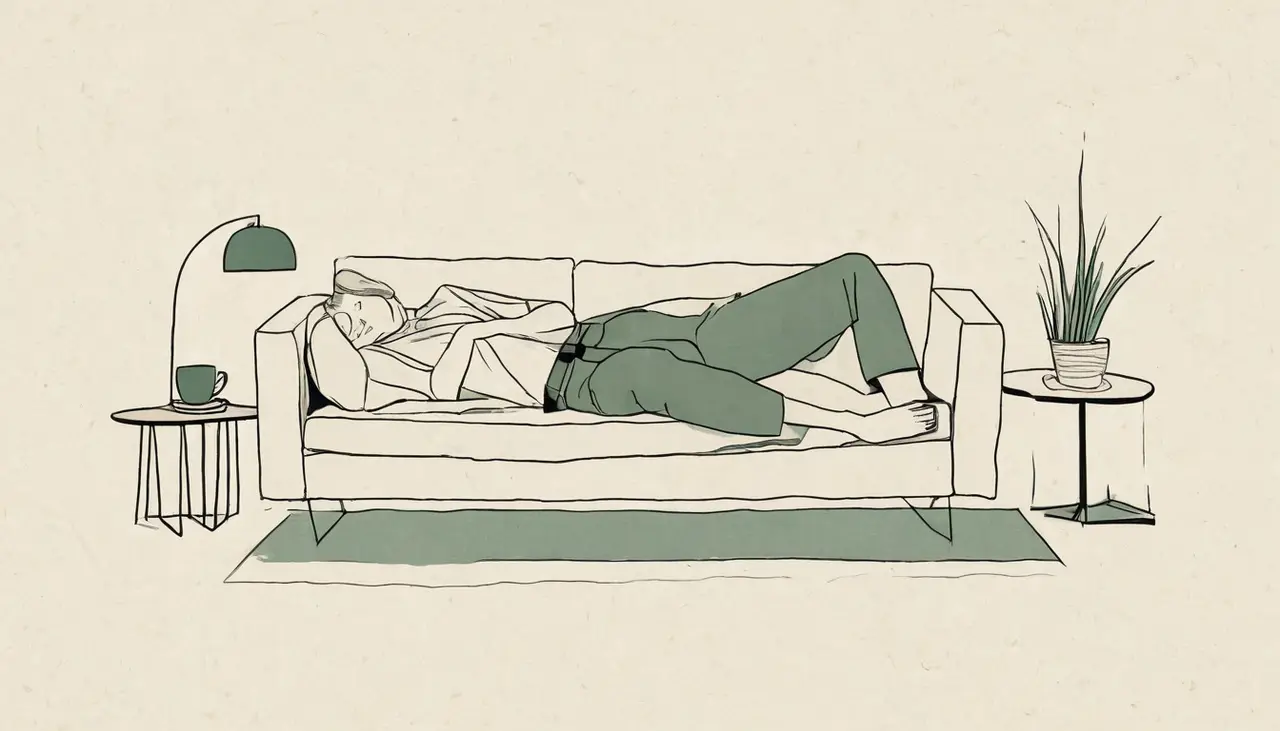
It is the first hour after a bad day. The laptop is finally shut, or the kids are finally down, or the last email is finally sent, and there is a small, specific hunger in you — not for food, for the click and pour and the first cold swallow that tells your shoulders they can come down now. You are not even deciding. Your hand is already moving.
That pull is real, and it is not a character flaw. Under stress your body reaches for a fast, reliable way to drop the tension, and alcohol is one it has already learned. So the goal here is not to white-knuckle a stressful week on willpower. It is to change one moment inside it, using a small routine you can run even when you are tired and fried. Call it the Stress-Window Reset.
Why the first hour is where plans die
A vague plan — "I'll be better this week" — is made on a calm Sunday by a calm version of you. The urge does not arrive on Sunday. It arrives Tuesday at 6:40 p.m., when you are depleted and the easiest thing in the room is the thing you were trying to skip.
That is the mechanics of a habit, not weakness. A cue — stress, a time of day, walking in the door — fires, a routine follows (pour a drink), and the relief teaches your brain to run the loop faster next time. The reason it feels automatic is that it has become automatic. Which is also the good news: a loop that was learned can be interrupted at the seam, and the seam is that first hour, before the first pour. Change the moment, not the whole month.
The Stress-Window Reset
Narrow your aim to a single window and put three small tools inside it. Not a lifestyle. A window and three moves.
Pick one window
Choose the single stretch where your plan usually falls apart, and only that one. The drive home. The first hour after work. Dinner prep. The stretch after the kids go to bed. Sunday night before the week starts. You are not trying to fix every drinking moment in your life this week — you are trying to change one, well enough to learn something from it.
Do it now: name your window out loud in one line — "the first hour after work" — and write it where you'll see it before you get there.
Buy ten minutes
You do not have to talk yourself out of the drink. You only have to move the decision later. Put one small action between the cue and the pour: eat something first, take a shower, walk once around the block, make a fizzy nonalcoholic drink, text someone. An urge is not a line that climbs forever; it tends to rise, crest, and ebb. Ten minutes of doing almost anything else lets the wave pass its peak before you decide.
Do it now: pick your one delay action and pre-stage it — glass by the sink, shoes by the door — so the easy thing and the better thing are the same thing.
Name what set it off
Say the trigger in four words, to yourself or into your phone. "This is work stress." "This is the argument." "This is just boredom." Naming it does something small and real: it turns an automatic reach into a noticed one, and a noticed urge is one you can actually decide about. Over a week it also shows you what your window is really made of.
Do it now: the next time your hand moves toward a pour, label the feeling before you touch the glass.
Set the stop before you start
Decide your stopping point while you are still clear-headed, not after the second drink when the deciding part of you has gone soft. Pick the number, or the "none tonight," or the "not until after dinner" — and, if it helps, write the count down before each pour so it stays visible instead of vanishing into the evening.
Do it now: before the first drink, say the ceiling: "two, then water," or "none until Thursday." Out loud counts more than you'd think.
A quick note on counting, since it only works if the units are honest. In the U.S., a standard drink is 0.6 fluid ounces — about 14 grams — of pure alcohol: a 12-ounce beer, a 5-ounce glass of wine, a 1.5-ounce shot. A generous home pour or a strong cocktail can quietly be two. If you are going to track, track in those units, or the number lies to you.
When one rough night isn't a verdict
Some evening this week, the Reset will not hold. You'll pour before the ten minutes are up, or blow past the ceiling you set. Read that as data, not a failure to be ashamed of.
The point of running a small experiment is to learn what actually happens when stress is high and the plan is specific — not to prove you can be perfect. Keep what worked, adjust what didn't, and one loud night inside a week that mostly went differently is still a week that went differently. The old loop has a hundred reps behind it. You are building new ones, and that takes more than a night.
What does deserve a closer look is a pattern. If the ceiling keeps collapsing — if stressful weeks routinely turn into what the CDC counts as binge drinking: four or more drinks for women, five or more for men on a single occasion — that is worth naming to a professional. Not because you failed the week, but because repeated loss of control is a real signal, and it is easier to work with early. Wanting to cut back rather than quit is a legitimate goal; you can say exactly that — "I want more control when I'm stressed" — and it is enough to start the conversation.
If a plain "I'll handle it with a routine" isn't holding and you want structure without a treatment program, a peer group can carry some of the load. SMART Recovery, for one, is a free, secular mutual-support program built around exactly this kind of work — a four-part framework for staying motivated, riding out urges, managing the feelings underneath them, and rebuilding a steadier week.
Two lines to hold onto, because stress plans can drift somewhere heavier. If cutting back ever brings on real physical symptoms — shaking, sweating, a racing heart, confusion — that is not something to push through alone: call the free, confidential SAMHSA helpline at 1-800-662-HELP, and treat shaking or confusion after stopping as an emergency and call 911. And if a hard week ever tips into feeling unsafe with yourself, the 988 Suicide and Crisis Lifeline is there by call or text, day or night.
Back to that first hour
Return to where this started: the shut laptop, the quiet house, the small pull toward the pour. Nothing about the Reset asks you to become a different person by Friday. It asks for one window and three moves inside it — buy ten minutes, name the trigger, set the stop before you start. Run it once this evening. Notice what happens. That is the whole first step, and it fits on one line: when the window opens, I'll ______ before I decide whether to drink.
This is general education for planning your own week, not medical advice or a treatment plan. If drinking less brings on physical withdrawal symptoms, or a hard stretch ever leaves you feeling unsafe, reach out right away — SAMHSA at 1-800-662-HELP, the 988 Suicide and Crisis Lifeline, or 911 in an emergency — and loop in a licensed clinician who knows your history.
- Body & physical health
Can You Develop Alcohol Intolerance? Why Drinking Feels Different
Yes, someone who drank comfortably for years can start reacting badly. Intolerance hits during or soon after a drink; a hangover arrives hours later. How to tell.
- Family & relationships
How to Talk to Your Kids About Your Drinking
General principles for parents who are cutting back and want to explain the change without over-sharing, over-promising, or putting adult weight on a child.
- Understanding your drinking
How Much Is Too Much Alcohol per Week?
There is no single safe weekly alcohol total. CDC's daily moderation definition and a standard-drink log show what a weekly sum can miss.
- Understanding your drinking
Why Do I Black Out When I Drink?
An answer-first Q&A on why alcohol blackouts happen, why they can happen after different amounts for different people, and when a memory gap is a safety warning.
- Mind & mood
Can Alcohol Cause Panic Attacks? Why They Hit After Drinking
An answer-first explanation of alcohol rebound anxiety, 3 a.m. panic, medical red flags, and how to read the pattern without self-diagnosing.
- Medication & treatment
How to Drink Less Without AA: A Practical Cutback Framework for People Who Aren't Doing a Program
Drinking less without AA works best as four weekly jobs: measure honestly, plan a number, prepare for the hard moment, and check in.


Be the first to hear when Clero launches.
Join with email only. Clero is still in development, so this is educational content today — not treatment, a prescription request, or medical advice.
First to hear at launchLaunch news only — no spamUnsubscribe anytime