
How to Drink Less When Going Out
To drink less when going out, decide the night's shape before the bar decides it for you. Four early moves, no announcements, no turning down the invite.
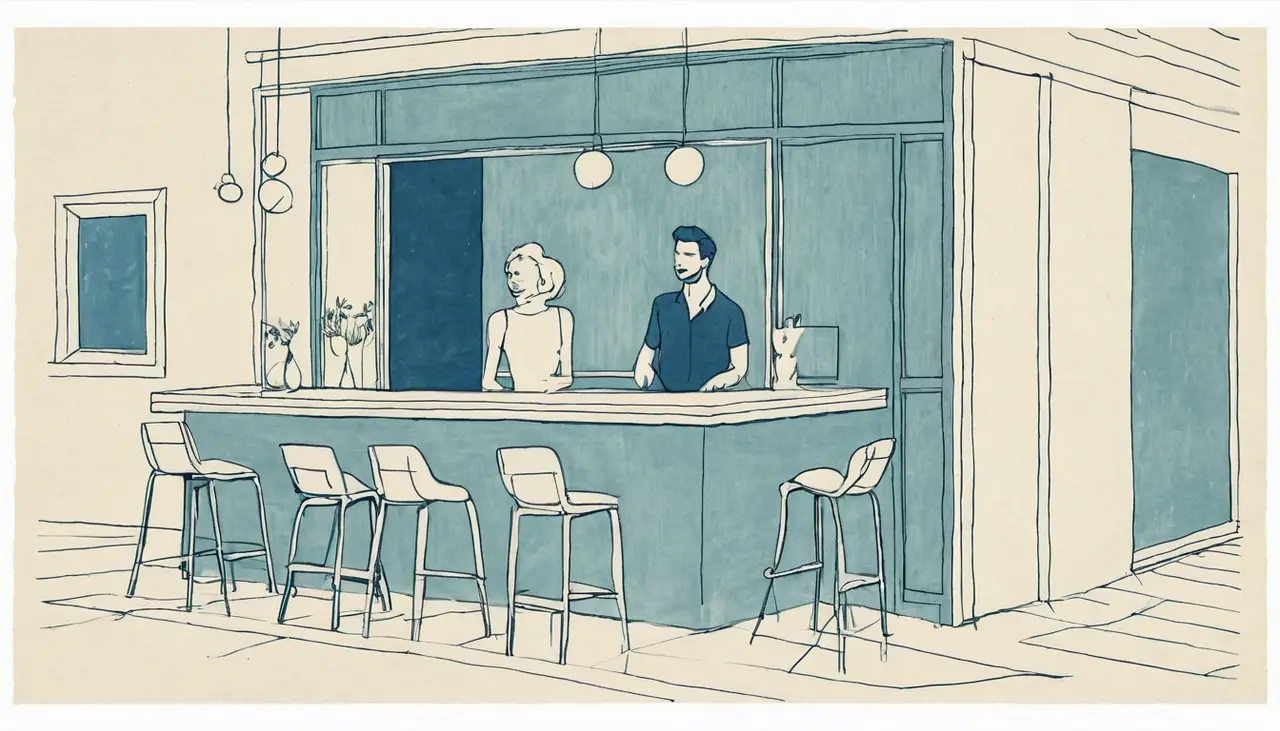
It's the second round, and the waiter is already looking at you. Your glass is empty, the table has that easy hum going, and someone has a card out to cover the next one. Saying "not for me" now feels like stepping off a moving train. So you don't. You get the drink you weren't planning on, and the whole night quietly shifts a notch past where you meant it to land.
Here is the thing nobody tells you about drinking less on a night out: the hard part isn't willpower. It's that a bar is built to make the decision for you. Rounds set the pace. Empty hands invite refills. The tab blurs the count. By the time you'd have to say no, saying no costs more than saying yes. So the move isn't to white-knuckle it in the moment. It's to decide the shape of the night while your hands are still on the wheel — before the room takes over the steering.
That's the whole idea here, and it has a name: the Steering Wheel. Four small decisions you make early, so the night follows a route you chose instead of drifting wherever the group current pulls it. None of them require announcing a plan or turning down invitations. They just move the choice back to a moment when it's easy to make.
Why the room drives, not you
A craving or a "sure, why not" isn't a character flaw showing up on cue. It's context doing exactly what context does. Drinking is one of the most cue-driven things we do: a setting, a smell, a clink of glasses, a hand offering you something — each one is a little prompt, and prompts stack fast in a bar. When five of them land in ten minutes, "I'll pace myself" stops being a decision you're actively making and becomes a current you're standing in — the same current behind only drinking when you're out with other people.
The other quiet problem is that the glass in front of you rarely holds what you think. If you're counting anything, count standard drinks, not glasses. NIAAA puts a U.S. standard drink at 0.6 fluid ounces — about 14 grams — of pure alcohol. A strong cocktail, a tall pour of wine, a 9% beer: any one of those can be two standard drinks arriving in a single glass. So "I only had three" and "I had six standard drinks" can be the same night. That's not a number to police yourself with. It's just the real unit, so your plan is built on what you actually drank instead of how many times a glass got set down in front of you.
Move the deciding earlier, and you're deciding while all of that still feels manageable. That's what the four moves do.
Set the shape before the first order
Pick one thing about tonight that you've already decided, and decide it now — before you walk in, ideally before you're hungry or tired. Not a rulebook. One shape. "I'm eating before I think about alcohol." "I'm out by midnight." "I'm not doing the second location." "Tomorrow morning stays intact." A single decided edge is easier to hold than a running tally you have to keep recalculating all night.
Do it now: before you leave, say one sentence out loud — "Tonight I'm ___." Fill in the one thing you're protecting. That's the shape. Everything else can flex around it.
Get something in your hand early
Empty hands are the single biggest generator of unplanned drinks. People offer because your glass is empty; you accept because refusing twice is awkward. Close the loop before it opens: get something you actually want to hold — water, a soda, a plain club soda with lime — into your hand early and keep it there. It doesn't need to be a special product or a performance of not-drinking. It just needs to occupy the slot the next drink would fill, so nobody's reading your empty hand as a request.
Do it now: at the bar, order your non-alcoholic thing first, before the group's first round lands. Whoever's buying will build the round around what's already in your hand.
Sit the round out, in one sentence
Rounds are the mechanism that turns your pace into the table's pace. The defense is a short line you can repeat without inventing a new excuse each time. "I'm good for now." "Sitting this one out." "I'm pacing tonight." "I'm on my own tab." Pick one and reuse it. You don't owe anyone the story of your relationship with alcohol, and a repeated line reads as settled, not as a debate you've reopened.
Paying your own way helps more than it sounds like it should. When you're inside a shared tab, every round is a group decision you're part of by default. When you're on your own tab, stopping is just… stopping. No one's out money, and there's nothing to opt out of.
Do it now: choose your one line before you go, so it's ready when the card comes out. Having it pre-loaded is the whole trick — you're not composing under pressure.
Name what you're protecting
This is the move that holds the other three together. "Drink less" is abstract, and abstract loses to a warm room at 11pm. So make it concrete: pick the specific thing tonight is actually for. Sleep. Tomorrow's run. The money. Being clear-headed with your kid in the morning. The ability to drive yourself home. When the third drink is on offer, "I'm cutting back" barely registers, but "I'm keeping tomorrow morning" is something you can feel.
Do it now: finish this sentence for tonight — "I'm protecting ___." Keep it to one word if you can. That word is what you're steering toward when the room pulls the other way.
When one night goes sideways anyway
Some nights the wheel slips. You join the round you meant to skip, the second location happens, you drink more than you planned. One rough night is not a verdict on you, and it's not proof the approach doesn't work — it's data about where the plan got overridden. The next morning, before the memory smooths itself over, write down the plain facts. What was the first drink? Who ordered the next one? Did the group move somewhere you hadn't planned? Which move held, and which one slipped?
Keep it factual, not moral. "I'm weak" tells you nothing to change. "I joined the first round even though I said I wouldn't" hands you a specific pressure point for next time. "I was fine until the second location" gives you a boundary. That's the whole point of reviewing it — not a verdict, just a sharper plan.
One honest note on memory, because it matters here: if whole stretches of the night are simply gone — not fuzzy, gone — that's a blackout, and it's worth taking seriously. Researchers describe blackouts as gaps that happen when blood alcohol rises fast enough to interrupt the part of the brain that files experiences into memory. Regular blackouts are a sign the pace is outrunning what your body can handle, not a funny story.
When "just drink less" isn't the right plan at all
The Steering Wheel is for steering a night, not for coming off heavy drinking. If you drink heavily or every day, or a stretch without alcohol has ever brought on shaking, sweating, a racing heart, confusion, or a seizure, then cutting back on a night out is the wrong frame entirely — stopping suddenly can be genuinely dangerous, and the safe version of this is planned with a clinician, not improvised at a bar. Talk with a clinician about what's safe for you before you change a heavy pattern. If you're not sure where to start, SAMHSA's National Helpline (1-800-662-HELP) is a free, confidential, 24/7 route to local support. And if a night ever turns into shaking, confusion, or a seizure, that's an emergency — call 911 or go to an emergency room.
It's also worth taking the pattern seriously if going out keeps ending in far more than you planned, blackouts, fights, risky situations, or the feeling that you can't stop once the first drink lands. That's not a label. It's a signal the situation deserves more support than a going-out plan can give.
The one thing to carry out
You don't need a system. You need your hands on the wheel before the room grabs it — one decided shape, something in your hand, one repeatable line, and one word for what you're protecting. That's it. The empty glass at the second round is the moment everything usually tips; the four moves just make sure you've already answered it before it arrives. Next time out, pick the one word first. The rest steers off that.
This is general education, not medical advice; if reducing or stopping alcohol ever feels physically unsafe, talk with a licensed clinician or call SAMHSA's National Helpline at 1-800-662-HELP.
- Body & physical health
Can You Develop Alcohol Intolerance? Why Drinking Feels Different
Yes, someone who drank comfortably for years can start reacting badly. Intolerance hits during or soon after a drink; a hangover arrives hours later. How to tell.
- Cutting back & moderation
Do Mocktails Actually Help You Drink Less? An Honest Look
Mocktails really can help you drink less — the glass and ritual do most of the work. For some, the flavor wakes cravings instead; a two-week swap test shows which.
- Mind & mood
How Can I Drink Less When I Am Stressed?
A moderation-valid Q&A for people who want to drink less during stressful weeks without committing to a new identity.
- Body & physical health
How Many Calories Are in Alcohol? A Plain Reference
A numbers-first reference for typical calories in beer, wine, and spirits, with standard-drink context and no diet plan.
- Medication & treatment
Scared to Stop Drinking? What to Ask a Doctor
If you are scared to stop drinking, ask a licensed clinician about your current drinking pattern, any symptoms you notice when you drink less, your medical history, and what level of support is appropriate. This page is questionprep only. It does not give detox instructions, taper schedules, or personal risk assessment.
- Understanding your drinking
Why Do I Black Out When I Drink?
An answer-first Q&A on why alcohol blackouts happen, why they can happen after different amounts for different people, and when a memory gap is a safety warning.


Be the first to hear when Clero launches.
Join with email only. Clero is still in development, so this is educational content today — not treatment, a prescription request, or medical advice.
First to hear at launchLaunch news only — no spamUnsubscribe anytime