
What to Do When Your Kid Asks About Your Drinking
A parent-side guide to short, honest, age-appropriate answers when a child notices your drinking or your cutback.
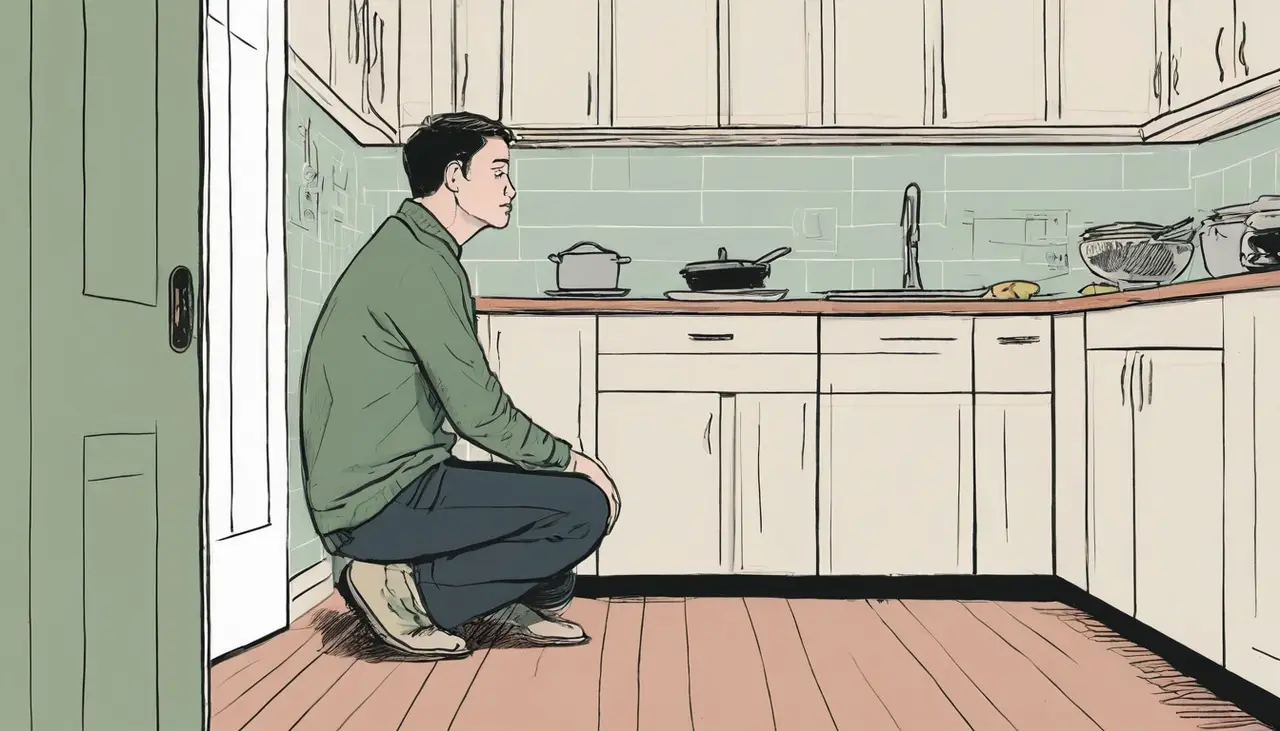
It's a Tuesday. You're rinsing bottles for the recycling and your seven-year-old is suddenly at your elbow, counting. "Why are there so many?" Or it's the older one at dinner, watching the pour: "Didn't you say you were stopping that?"
Your face does something. You buy a second with "What?" — and in that second a whole courtroom convenes in your head. You don't need the courtroom. You need four sentences.
The freeze is normal, and it isn't evidence you've failed as a parent. A kid's question about your drinking only lands that hard because you care what the answer means for them. So here is one tool for the moment: the Four-Sentence Answer — one sentence that confirms what they saw, one small true reason, one sentence for the fear underneath, and one that leaves the door open. That's the whole thing. You can build yours tonight.
Kids ask about what they can see
Kids are pattern-readers. They clock the glass that appears at six, the mood after the second one, the sudden absence of wine at dinner. When the pattern changes — more drinking, or abruptly less — they ask about the visible part: the bottles, the glass, the new rule. The question underneath is usually smaller and scarier. Are you OK? Is our family OK?
It's also a far more ordinary question than it feels like from inside. In NIAAA's summary of federal survey data, an estimated 19 million U.S. children in 2023 lived with at least one parent with a substance use disorder — and most of that was alcohol, over 12 million children. That's context, not a verdict on your household. It just means a kid asking about a parent's drinking is one of the most common hard moments in American family life.
Why does a short answer beat both the lecture and the breezy "everything's fine"? Because a kid who doesn't get orientation writes their own version of events, and a child's imagination is not a gentle author. Four true sentences close the gap between what they noticed and what they know — without asking them to carry anything adult-sized.
Confirm what they noticed
Sentence one agrees with reality. "You're right — I haven't been having wine at dinner." "Yeah, that was a lot of bottles this week." Denying something a kid has plainly seen teaches them one of two lessons: my eyes are wrong, or my parent lies to me. Neither one helps you later.
Do it now: pick the thing your kid is most likely to have noticed — the recycling, the after-work glass, the change — and say your confirming sentence out loud once, alone, so the first time isn't live.
Give one small, true reason
Sentence two keeps the reason body-sized, not moral-sized. "It was messing with my sleep, so I'm drinking less." "I feel better in the mornings when I skip it." A health-and-feelings frame hands them something true they can actually understand, without handing them your history. You're allowed to summarize. A kid needs the weather report, not the memoir — honest doesn't mean exhaustive, it means nothing you say is false.
Do it now: write your reason in ten words or fewer. If it wouldn't make sense to your kid's best friend, simplify it.
Say the thing about them out loud
Sentence three answers the question they may never voice: "I'm OK. And this has nothing to do with anything you did." If the question is "Did you stop because of me?", the no has to be flat and warm at the same time. Kids quietly assume they cause the household weather; a direct sentence is how you take that off their shoulders, and it usually needs saying more than once over the years.
Do it now: say both of those sentences today, even if the question hasn't come yet. They're the two your kid most needs in the bank.
Leave the door open — and keep the job
Sentence four: "You can ask me about this whenever you want." Then stop. The door stays open; the job stays yours. Don't ask them to count your drinks, watch the fridge, or cheer you on — a child makes a costly accountability partner, and they pay the cost. Skip the vow you can't guarantee, too. "I will never drink again" feels generous in the moment, but a broken promise turns a curious kid into a scorekeeper.
Do it now: notice the one extra thing you were tempted to add — the history, the vow, the apology tour — and cut it.
When four sentences aren't enough
Honest limit: this tool handles a question. It doesn't handle a frightened kid. If your child asks fear-shaped questions again and again, is scared after one specific night, or has started acting like the family's smallest adult, what's needed is more adults — a pediatrician, a school counselor, a family therapist. Bringing them in isn't an admission that things are terrible; it's what the open door was for.
Age changes the traffic, not the road. A five-year-old may take sentence one and wander off. A fourteen-year-old may push — "So how much were you drinking?" or "What does drunk even feel like?" That's curiosity plus a fairness test, not a request for your data or a seminar. You can keep the same four sentences and add "fair question — here's the short version" without promoting them to confidant.
And if what stops you from answering at all is shame — the sense that saying it out loud makes it real — that pull has a name. NIAAA describes stigma as a pervasive barrier that keeps people from getting help with alcohol, and it presses extra hard on parents, because the fear isn't just judgment — it's judgment about your parenting. Worth knowing the pull is predictable, because the predictable next thought is:
Hiding it better is the other option
Take that option seriously for a second, because most parents consider it: drink later, drink elsewhere, manage the evidence. It fails on two counts. First, they asked — which means they were already reading the pattern, not the props, and the pattern (routine, mood, absence) can't be hidden in a cabinet. Second, there's a real difference between privacy and secrecy. You don't owe your child every detail of your adult life; that's privacy, and it's healthy. Secrecy is asking them to disbelieve what they can see — and sooner or later they experience that as being lied to. Keep the adult things adult. Just don't make their own eyes the thing you argue with. If the deeper worry is what your drinking is doing around your kids in general, that question has its own page.
The next time the question comes
Back to the kitchen, the bottles, the kid at your elbow. The question will arrive on a day you didn't pick, which is exactly why the answer is worth building on a day you did. Write the four sentences tonight: what they saw, the small true reason, the "you didn't cause this," the open door. Fold the paper into your wallet if you have to.
One more thing, because it's often the real reason this page got opened: if the question rattled you because some part of you has been asking it too, treat that as information. A useful first step is knowing your actual number — NIAAA counts one standard drink as 0.6 fluid ounces, or 14 grams, of pure alcohol, which is often less than what a real-world pour holds. And you don't have to sort out alone whether your number is a problem. If you don't already have a clinician you'd bring this to, Clero can connect you with a licensed clinician by telehealth to talk through where your drinking stands and what cutting back could look like, including whether medication support fits.
Your kid didn't ask for a perfect parent. They asked about the bottles. Four sentences, said plainly, tell them the two things they actually came for: you're OK, and so is the family. That, you can do.
This is general education for a hard parenting moment, not medical or parenting advice. If drinking or cutting back ever comes with thoughts of harming yourself, call or text 988; if stopping brings shaking, confusion, hallucinations, or a seizure, call 911 or go to an emergency room; and for a free, confidential treatment referral in an urgent moment, SAMHSA's National Helpline is 1-800-662-HELP.
- Family & relationships
Talking to Your Kids About Alcohol: What Works at Every Age
A parent guide to small alcohol conversations, age-banded scripts, modeling, teen safety questions, and what underage-drinking data actually says.
- Family & relationships
How to Set Boundaries With Family When You're Cutting Back on Drinking
A calm guide to extended-family drinking pressure, short answers, and exit plans when you are trying to drink less.
- Mind & mood
The Secret Pride of Cutting Back When No One Notices
A guide to private cutback wins, silent progress, internal validation, and the urge to share without forcing disclosure.
- Helping someone who drinks
How to Help an Alcoholic Parent When You're the Grown-Up Child
You can't make a parent stop drinking, and you were never supposed to be the one managing it. What actually helps, what to say once, and where the hard limits are.
- Tools & resources
The Best Podcasts To Help You Quit or Cut Back on Drinking
A situation-based guide to sobriety and alcohol-cutback podcasts, how to choose one, and when audio is not enough support.
- Family & relationships
What to Do When Your Spouse Comes Home Drunk
If your spouse comes home drunk, check for danger and wait to discuss drinking. Know when to call 911 and how to put household safety first.


Be the first to hear when Clero launches.
Join with email only. Clero is still in development, so this is educational content today — not treatment, a prescription request, or medical advice.
First to hear at launchLaunch news only — no spamUnsubscribe anytime