
Drinking and Feeling Lonely When You Can't Tell Anyone You're Cutting Back Yet
Why the private early cutback window can feel lonely, what to notice inside it, and when emotional or alcohol-related support matters.
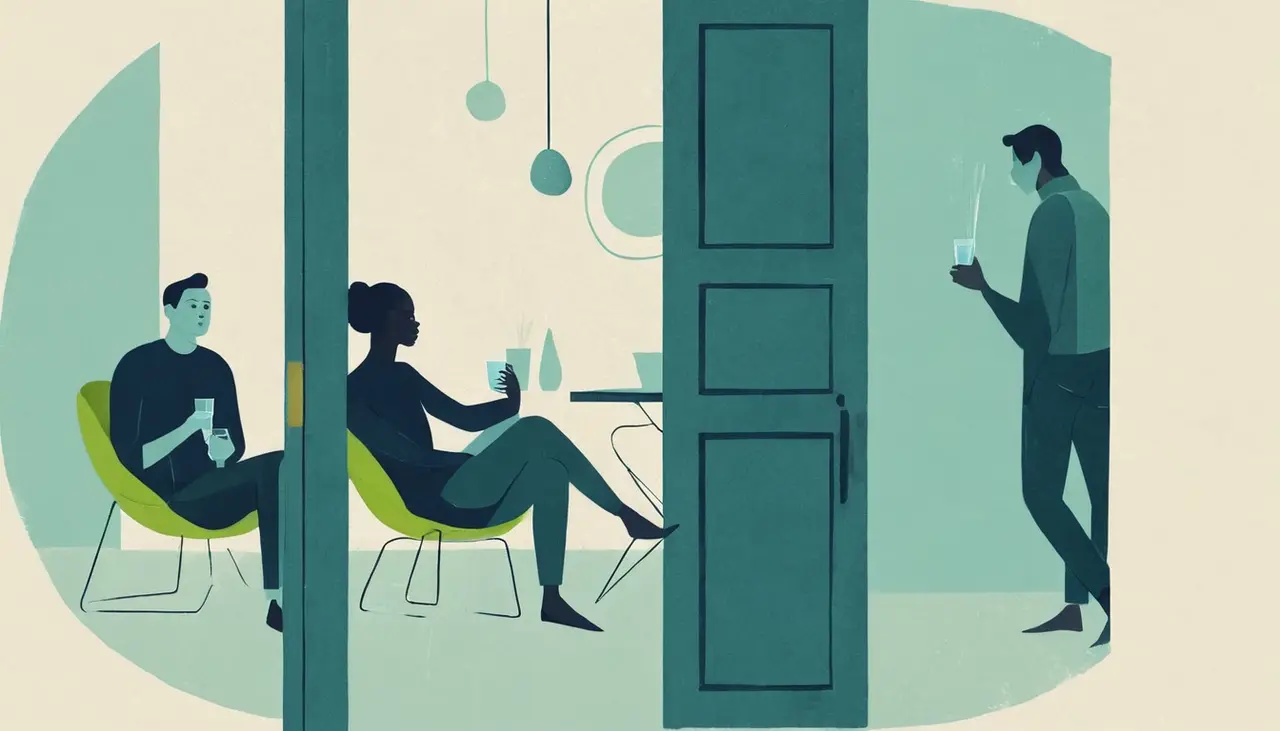
The third glass of seltzer of the night has gone flat, and the lime has sunk to the bottom, and across the room someone is refilling a wine glass without thinking about it at all. You are the only person here keeping count. Not out loud. Just a quiet tally running behind your eyes — two Fridays now, or is it three, that you have swapped the drink for the fizzy water and said nothing.
Nobody knows. That is the strange weight of it. You have changed something real, and the change is invisible, and there is no one in the room you have decided to tell yet — not the partner in the kitchen, not the friend on the couch, not a doctor, not a sibling on the other end of a text you keep drafting and deleting.
This is a particular kind of loneliness, and it is worth naming carefully, because it is not the same as being alone. You could be surrounded by people, laughing, warm, and still be the only one who knows what the seltzer means. Being alone is a room with no one in it. This is a room full of people and one closed door.
Stigma keeps the door closed. NIAAA describes stigma as one of the reasons people delay reaching out about drinking at all — and that is really a sentence about the space between wanting a witness and being ready to choose one. You can want to be seen and still not be ready for the seeing. Both things can sit in the same chest at the same time.
*
Here is the question under the question. It is not should I tell someone. It is quieter than that: does this count if no one sees it.
It counts. The effort is real whether or not it has an audience. But the effort is also invisible, and invisible effort has a way of getting heavy, because there is no one to reflect it back — no one to say I noticed, no one to hold the other end of the rope while you climb. You are doing the pulling and the watching both.
Some people, in this early stretch, make the paper the witness. Not a confession, not a diary poured out — just a mark. A tally on the back of a receipt. A single line about which craving hit hardest, and when. If the counting helps, it helps to count the same thing each time, and there is a shared unit for that: a U.S. standard drink is 0.6 fluid ounces, or 14 grams, of pure alcohol — the pour, not the glass. It is a plain way to make the private record less slippery than a little or too much. The note does not judge. It just remembers, so you do not have to hold the whole thing alone in your head.
There is a difference, too, between a witness and an audience. A witness can be one line on a receipt, one honest question to a clinician, one anonymous voice at the other end of a line at two in the morning. An audience is everyone who might have an opinion — the family group chat, the coworker who overshares, the friend who will make it a story. You are allowed to not be ready for the audience. That is not the same as having no witness at all. The danger is not privacy. The danger is a private room with no door left in it.
*
For most of this stretch, the loneliness is heavy but ordinary — the weight of carrying something without help, nothing more. It lifts when a change becomes something you are living instead of hiding.
But heaviness is not the same as danger, and it matters to know where the line is. If the loneliness stops being an ache and starts being a drop — if it slides into a flat, sustained low; into hopelessness; into thoughts of hurting yourself, or the sense that you cannot keep yourself safe tonight — that is no longer a private window to sit inside. The 988 Suicide and Crisis Lifeline is there for exactly that, free and confidential, by call or text, and it does not require you to have told anyone else first. If the danger is immediate, that is 911, that is an emergency room, that is now. Privacy is not worth your safety. Nothing is.
There is a smaller, quieter line worth watching too. If the drinking itself has become daily and heavy, stopping suddenly is not always a thing to do alone — a body used to alcohol every day can react hard to its absence, and that is a conversation for a licensed clinician, not a secret to keep. If you do not have a clinician to bring it to, Clero is being built to connect you with one by telehealth, privately, to talk through whether a medication for alcohol use is worth considering — the kind of first conversation that does not require walking into a waiting room where someone might see you.
None of that means the invisible cutback was a failure. If anything, the numbers point the other way. In 2024, an estimated 27.9 million people ages 12 and older in the United States had past-year alcohol use disorder, and only about 2.1 million of them — roughly 7.6% — received any treatment that year. The diagnosis may not fit you at all. But the gap in those two numbers is a whole landscape of people who noticed something and stayed quiet about it, sometimes for years. You are early. Early is not late.
*
So the seltzer sits there, flat, and the tally runs, and no one in the room knows. It is tempting to read that as proof the change is not real yet — that until someone witnesses it, it is only rehearsal.
Try the inversion. The privacy is not the change failing to become real. It is the change getting its first quiet stretch to take root before anyone else's hopes or doubts get their hands on it. A seed does its first growing underground, in the dark, unwatched, and that is not the seed hiding. That is just where roots go first.
The only thing the dark asks of you is a door. Not an audience. Not a confession by Friday. One way out — one line on a receipt, one number you would be honest about, one person you might tell when the week is less fragile, one phone number for the night the loneliness turns to something heavier than loneliness. Keep the door, and the private window stays a window. Lose it, and the same quiet becomes a wall.
You do not have to tell the room tonight. You only have to leave yourself a way back into it.
This is general education about a common experience, not a therapy plan or a crisis service; if the loneliness ever turns unsafe, reach 988 or emergency help right away, and bring the drinking itself to a licensed clinician when you are ready.
- Cutting back & moderation
How Long Does It Take to Feel Better After Cutting Back on Drinking?
There is no single clock: mental speed tends to pick up within a month, most cognitive function over 6 to 12. Why sleep and anxiety often get worse first.
- Family & relationships
Cutting Back When Your Sibling Asks Why You're Not Drinking
When your sibling keeps asking why you're not drinking, one flat answer repeated beats a better argument. The Two-Foot Rule for getting through the family thing.
- Medication & treatment
Do I Have to Tell My Doctor I'm Cutting Back on Drinking?
No, you don't have to tell your doctor you're cutting back — but one honest sentence usually helps more than it costs. When it matters, and how to start small.
- Body & physical health
Does Cutting Back on Alcohol Make You Tired?
Yes, feeling more tired after cutting back on alcohol is common, because your sleep is still rebuilding. How long it lasts, and when fatigue is a warning sign.
- Body & physical health
What Are the Signs Your Liver Is Healing?
A conservative answer to why no symptom proves liver healing, which changes people may notice after cutting back, and when liver concerns need clinician review.
- Body & physical health
Drinking and Feeling Puffy or Bloated
Puffiness after drinking is mostly a fluid rebound; the bloated stomach is a separate gut effect. Why salt and short sleep make it worse, and what actually helps.


Be the first to hear when Clero launches.
Join with email only. Clero is still in development, so this is educational content today — not treatment, a prescription request, or medical advice.
First to hear at launchLaunch news only — no spamUnsubscribe anytime