
How to Cut Back When Your Partner Still Drinks
You can cut back when your partner still drinks — they don't have to change a thing. A rule set in advance, a stocked fridge, and one short line beat willpower.
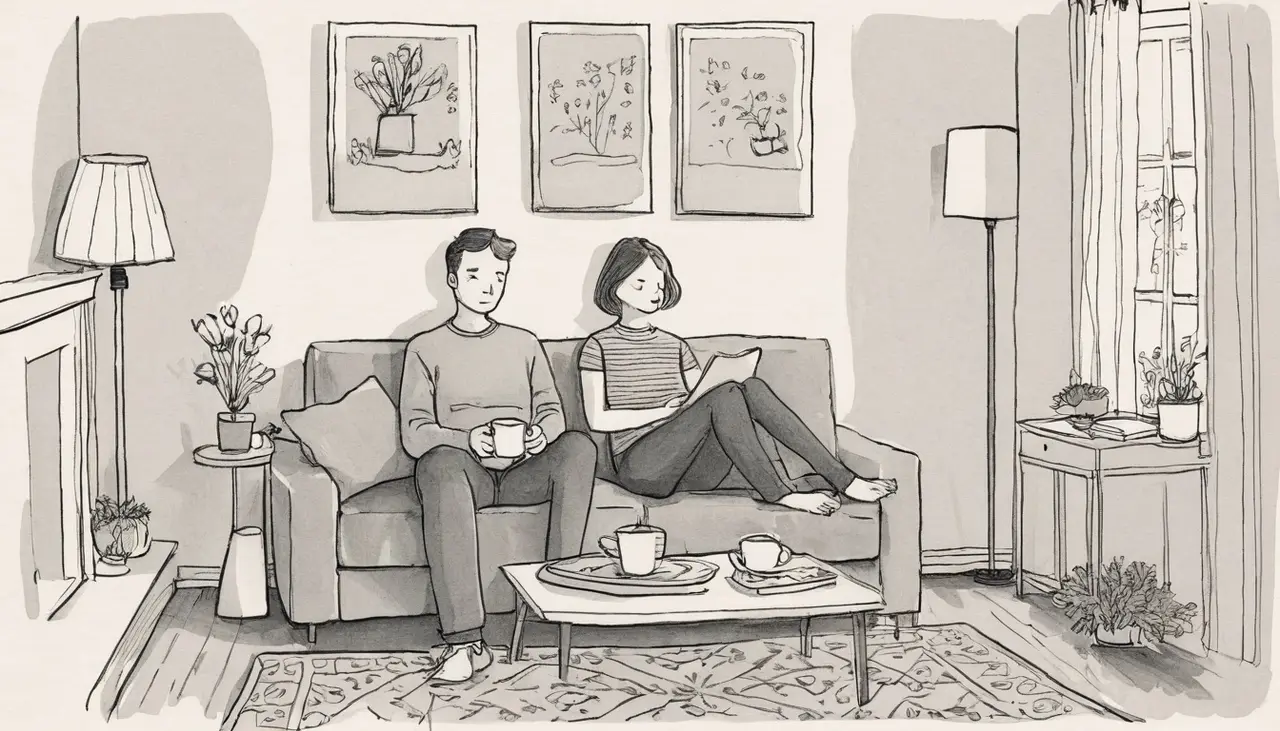
It is a Tuesday, nothing special. You have decided you are not drinking tonight. Then the cork comes out across the kitchen, the glug of the pour, your partner settling into the couch with a full glass and the easy face of someone who will have exactly one and forget about it. The fridge still hums with the same beer it always has. Nobody is pressuring you. That is almost the hard part — the choice is entirely yours, and it is sitting right there in front of you, cold and familiar.
Here is something worth knowing at the start: you can do this without them doing it too. You do not need your partner to quit, to hide the wine, or even to agree with you. You need a way to hold your own line in a room where the old routine is still running. That is a solvable problem, and it has less to do with willpower than with setup.
This is a setup problem, not a strength problem
The pull you feel is not a character flaw. Drinking is woven into ordinary evenings for a huge number of households — in 2024, about 57.9 million people ages 12 and older, or roughly one in five, reported binge drinking in the past month, per NIAAA. A partner who drinks while you cut back is not doing anything strange. That is exactly why it is hard: the cue is normal, visible, and always in arm's reach.
So stop trying to out-muscle it. What follows is a small kit for building your own lane — a way to drive alongside your partner's drinking without swerving into it and without forcing them off the road. Four moves, one conversation. None of them requires them to change a thing.
Why the room keeps pulling at you
A craving in a shared house is mostly a trained reflex. Your brain learned a loop: a cue (the couch, the clink, six o'clock), then the action (a drink), then a small reward (the edge comes off). Run that loop enough times and the cue alone starts firing the whole sequence before you have decided anything. When your partner pours, they are pulling the same lever your brain has wired to "drink."
Two facts make this workable. The cue does not force your hand — it just makes the old action feel automatic, and automatic can be overridden with a plan already in place. And the urge itself is not a rising line; it tends to crest and then fade, often within minutes, if you can put something between the cue and the pour. The lane you are building is really just a set of things you decided in advance so you are not deciding in the heat of the moment.
The Own-Lane kit
Draw the line before you need it
Vague goals collapse the instant a glass appears. "I'll take it easy tonight" is not a lane; it is a negotiation you will lose. A rule is a line you drew earlier, when you were calm, so present-you does not have to argue with anyone.
Make it a sentence about your behavior, not your partner's: I don't drink on weeknights. I don't drink at home. I wait until after dinner to decide. I'm taking thirty days. Pick one you can hold and say out loud without explaining your whole history.
Do it now: Write one rule on your phone's lock screen. One line. Present tense.
Stock your lane
If your only cold, ready, hand-in-reach option is alcohol, the cue wins by default. Give yourself a real one. A cold nonalcoholic drink you actually like, front and center in the fridge, poured into a proper glass — not a can hidden behind the milk.
The point is not the drink itself. It is that when six o'clock fires the reflex, your hand has somewhere else to go that is just as easy as the old thing.
Do it now: Buy or make one nonalcoholic option you like, and put it where your partner's beer usually sits — the front.
Bend one groove
You do not have to blow up the whole evening. Find the single moment where the first drink usually happens — cooking, the start of a show, the porch after work, the cleanup after the kids go down — and change one small thing about just that moment.
Take a ten-minute walk before dinner. Sit in a different chair. Start the show with tea already poured. You are not rebuilding your life; you are putting a bend in the one groove that runs straight to a drink, so the reflex misses.
Do it now: Name the one moment your first drink usually lands, and pick a single tweak to try tonight.
Say the line, then let it go
The glass will get offered. Someone will say "want one?" and you do not want to give a speech or a confession every time. So write your line ahead of time, keep it short and light, and practice it until it is boring.
I'm good tonight. I'm off weeknights right now. Not for me, but you enjoy. Deliver it flat and move on — no justification, no debate. The less weight you put on the sentence, the less weight the whole evening carries.
Do it now: Pick your one sentence and say it out loud twice, so it is ready before the question comes.
The one conversation to have
Have this once, at a neutral time — not while either of you is pouring, not mid-argument. Keep it short and make it about you.
Try: I'm working on my own drinking. I'm not asking you to change anything. It'd help me if we didn't make my choice the center of the night.
If you want a concrete favor, ask for one plainly rather than turning it into a loyalty test: Please don't offer me a drink after I've said no. I'm keeping my own drinks at the front of the fridge. I might step out for ten minutes after work before I sit down. A request your partner can actually say yes to is worth ten hints they have to decode. And skip the verdict on their drinking — you can protect your lane without putting theirs on trial.
When one night falls apart
It will, at some point. You will pour one you told yourself you would not, or the walk will not happen, or the line will come out shaky and you will end up in the argument you were trying to avoid. That is one evening. It is not the whole thing coming down, and it is not proof the plan does not work for you.
The lane holds because you rebuild it the next day, not because you never leave it. Notice which cue got you — the specific moment, the specific pour — and firm up that one part. A slip is information about where the lane needs a guardrail, nothing more.
There is one exception where "just try again tomorrow" is the wrong answer. If cutting back leaves you physically unwell — shaking, sweating, waves of nausea, a racing heart, a rattled and anxious feeling when you go without — that is your body reacting to the absence of alcohol, and it is a medical question, not a willpower one. Talk with a licensed clinician before you push further. If a stretch without drinking has ever brought on confusion or a seizure, treat it as an emergency and call 911. And if the drinking is tangled up with feeling unsafe with yourself, you can reach the 988 Suicide and Crisis Lifeline any time, or call SAMHSA's free, confidential line at 1-800-662-HELP (4357).
Where this leaves you
Back to that Tuesday, the cork already out across the kitchen. Nothing about the room has changed — the beer is still cold, your partner is still happy, nobody is watching to see what you do. What changed is that you are not deciding anymore. You decided earlier. You have a rule on your lock screen, something good already poured, one groove bent out of the way, and a flat little sentence ready for when the glass gets offered.
Pick two of those to set up before your next evening. That is the whole move: build the lane once, hold it in small pieces, and let your partner drive theirs.
And if the person across the kitchen is a roommate rather than a partner, the lane-building works the same but the politics are different — cutting back when you have a roommate who drinks covers that setup.
This is general education about changing your own drinking — not couples counseling, family therapy, or advice about whether to stay in a relationship. Whether cutting back is safe for your body is a question for a clinician who knows your history.
- Body & physical health
Does Alcohol Affect Your Taste Buds and Sense of Smell?
Yes — alcohol really can change how things smell and taste, dulling some senses and sharpening others. What's moving, and what recovers if you cut back.
- Social events & holidays
How to Handle Friends Who Keep Offering You Drinks
When friends keep offering you drinks, repeat one flat line instead of re-explaining. Justifying reopens the vote; five moves that hold without a speech.
- Social events & holidays
How to Handle a Baseball Game or Stadium Event While Cutting Back
At a ballgame, set your number before the first pitch and count the 24-ounce souvenir cup as two drinks, not one. A plan that runs on the game's own rhythm.
- Social events & holidays
How to Handle a Concert or Music Festival When You're Cutting Back
At a concert or festival, the drinking happens in the gaps: set changes and bar lines, not the music. Plan the set breaks and the day stays yours.
- Social events & holidays
How to Handle the Fourth of July When You're Cutting Back
A ten-hour Fourth of July pours itself unless you set edges first. Decide your leave time and drink number in the car, then keep a non-alcoholic can in hand.
- Social events & holidays
Cutting Back After a Wedding Weekend
One heavy wedding weekend doesn't end your cutback — it's data, not a verdict. Let your body recover first, repair only what needs it, then guard one weak point.


Be the first to hear when Clero launches.
Join with email only. Clero is still in development, so this is educational content today — not treatment, a prescription request, or medical advice.
First to hear at launchLaunch news only — no spamUnsubscribe anytime