
Drinking and the Pressure to Toast at a Summer Dinner or Event
How to think through the specific pressure of a coordinated toast when you are cutting back, without one-size-fits-all etiquette rules.
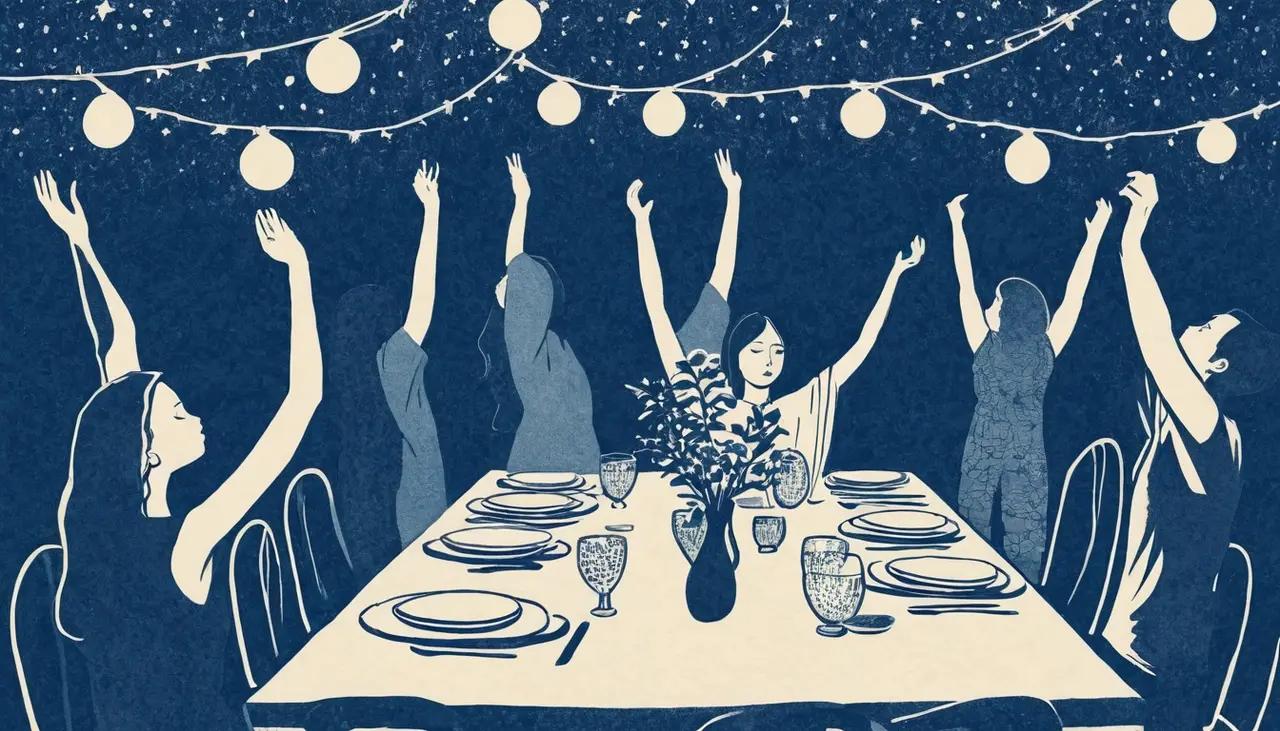
The clink comes before you are ready for it. A fork taps the side of a glass, a chair scrapes back, and the whole long table turns toward the person standing. Somebody says a few words about love, or years, or the one who is gone. Then everyone lifts. And in that half-second your own glass — the flat seltzer, the ginger ale gone warm, whatever you chose on purpose an hour ago — feels lit from inside, as if the whole room could read it.
Nobody is actually looking at your glass. They are looking at the person being honored, at their own hands, at the light. But the toast has a way of pulling the eye inward, and for a beat you are sure the ginger ale has a spotlight on it.
That is the strange thing about a toast. Unlike an ordinary drink being offered — an offer gives you room, a few seconds, a small no, a shrug that closes the subject — a toast collapses the room into one motion at one instant, and asks you to move with it or not, in front of everyone, while a speaker's voice still hangs in the air. What it presses on is rarely the alcohol itself. It is the brief, public synchrony of the thing, and the question of whether your glass joins the chord.
The occasions that carry toasts are the ones that carry weight. An engagement. A retirement after thirty years. A birthday with a number that means something. A memorial where the raised glass stands in for a person who cannot lift one. On nights like those a glass stops being a beverage and starts being a small pledge — of loyalty, of grief, of belonging to the table. That is the freight the seltzer has to carry, and it is heavier than the seltzer.
Here is the question underneath the obvious one. The obvious question is whether you have to drink for the toast to count. The truer question is whether you can be present in the same moment as everyone else while holding something different in your hand.
You can. People do it constantly — at every table there is a driver, a guest who is pregnant, someone on a medication, someone who simply did not want another. The gesture is the raised glass and the eye contact and the willingness to mean the words. The liquid is almost beside the point. What the moment asks for is participation, and participation is not poured.
But the panic is real, and it deserves an honest look rather than a pep talk. For most people the dread is not a craving for the drink at all; it is the fear of being seen deciding. Those are different animals, and telling them apart in advance changes what you need. If the pull is toward the alcohol, that is one kind of evening. If the pull is only away from being watched, then the thing to manage is the watching, not the wine — and the watching is almost always shorter and dimmer than it feels from inside it.
What helps is deciding before the clink, not during it. Not a rigid rule, not a script memorized like lines — just one small settled thing so the moment arrives already answered. Where you will stand. What will be in your glass. Whether, for you, tonight, a single ceremonial sip is a closed parenthesis or the first domino of the whole night. That last one is worth being plain with yourself about, because for some people a lone ritual sip changes nothing, and for others the first is never the last. You know which you are on a given night better than any etiquette column does.
If you do choose to hold the same drink as the room, it still counts toward the night. A ceremonial glass is not exempt from the tally just because a speech came with it. A U.S. standard drink is 0.6 fluid ounces, or 14 grams, of pure alcohol — the same arithmetic whether it is poured over a graduation or a Tuesday. That is not a scold. It is just the reason the toast can feel like a hinge: one glass here can quietly open the next.
And there is a small, unsentimental fact worth keeping in a back pocket for the quiet after. The drink that seems to soften a keyed-up evening does not buy the sleep it promises. Alcohol can shorten the time it takes to fall asleep, then fragment the back half of the night and blunt its deepest stretches, which is part of why a celebratory nightcap so often hands you a 3 a.m. ceiling and a thin, unrested morning. The toast asks for a moment. The body keeps the receipt.
If you are the one being honored, the pressure inverts. Now the glasses are lifted toward you, and there is a peculiar guilt in holding back at your own celebration, as if the plain seltzer might dim someone else's joy. It will not. The people who love you raised their glasses to you, not to what you were drinking. Their toast lands the same.
And if you are the one giving the toast, the glass can feel like a prop you are contractually holding — part of the performance, expected to be drained. It is not. The words are the offering. The glass is only somewhere to put your hand.
Picture the clink again, but from a little further back this time. The table turns, the speaker finishes, the arms go up in their brief ragged unison. You lift too — warm ginger ale, cold seltzer, whatever you chose — and you hold the gaze of the person the night is for, and you mean it. No one clocks the color of your drink. The moment does what it came to do and then dissolves, the way moments do, into passed bread and someone laughing too loud and the ordinary rest of the evening.
What looked from the inside like a spotlight was only a room full of people, briefly, facing the same direction. You were part of it the whole time. The glass in your hand was never the thing being toasted.
If you drink daily or stopping abruptly has ever felt physically unsafe, that is worth talking through with a licensed clinician before you change anything — this piece is a companion for the moment, not medical or etiquette advice.
- Family & relationships
Cutting Back When Your Sibling Asks Why You're Not Drinking
When your sibling keeps asking why you're not drinking, one flat answer repeated beats a better argument. The Two-Foot Rule for getting through the family thing.
- Medication & treatment
Do I Have to Tell My Doctor I'm Cutting Back on Drinking?
No, you don't have to tell your doctor you're cutting back — but one honest sentence usually helps more than it costs. When it matters, and how to start small.
- Body & physical health
Does Cutting Back on Alcohol Make You Tired?
Yes, feeling more tired after cutting back on alcohol is common, because your sleep is still rebuilding. How long it lasts, and when fatigue is a warning sign.
- Family & relationships
How to Talk to Your Kids About Your Drinking
General principles for parents who are cutting back and want to explain the change without over-sharing, over-promising, or putting adult weight on a child.
- Cutting back & moderation
What to Do With the Alcohol Already in Your House When You're Cutting Back
A safety-first way to think about the alcohol already at home without one-size-fits-all rules or cold-turkey advice.
- Body & physical health
Drinking and Tinnitus or Ringing in Your Ears
Ringing after drinking is usually a short spike, and the loud bar and thin sleep may matter as much as the alcohol. How to read your pattern, and when it's urgent.


Be the first to hear when Clero launches.
Join with email only. Clero is still in development, so this is educational content today — not treatment, a prescription request, or medical advice.
First to hear at launchLaunch news only — no spamUnsubscribe anytime