
Late-Night Eating After Drinking
Late-night eating after drinking isn't weak willpower — alcohol can trip the brain's hunger alarm while quieting the brake. The loop, and where friction helps.
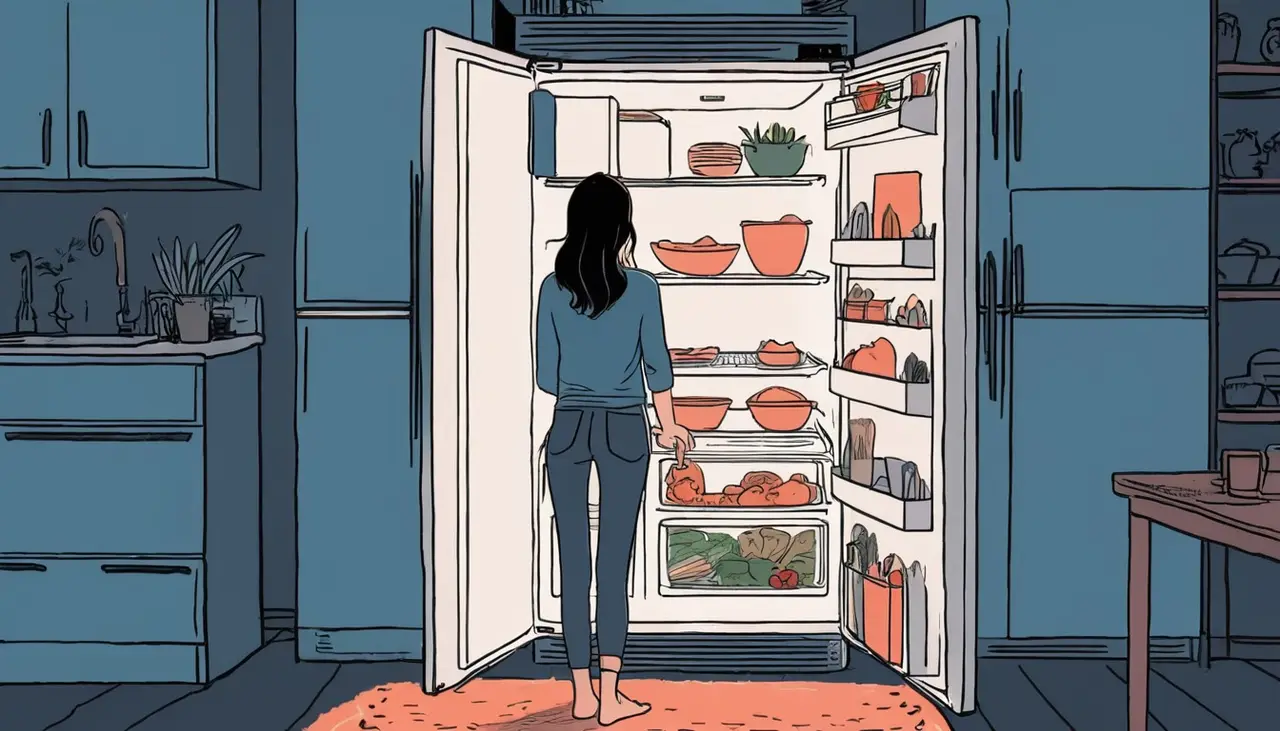
The phrase people reach for is "drunk munchies," and it usually arrives with a shrug — as if the bag of chips at midnight were a small character failure, willpower running out at the worst hour. Blaming yourself is a tidier story than looking at what alcohol was actually doing to the parts of the brain that decide when to eat. Those parts were busy. So the more useful question is not "why am I so weak at night" but why drinking so reliably ends with food you did not plan and barely tasted.
Why a few drinks turns the hunger up
Start with the strangest part. Alcohol carries a lot of calories, and calories normally quiet hunger — eat enough and the brain reads "full" and stops sending you to the kitchen. Alcohol skips that step. In a 2017 study in Nature Communications, researchers gave mice alcohol at doses scaled to a human's and watched a specific cluster of brain cells — the AgRP neurons, the ones that normally fire during real starvation and produce that gnawing "I need to eat now" feeling — switch on instead of going quiet. When the team silenced those neurons, the alcohol-driven overeating stopped. Put plainly: alcohol can trip the brain's famine alarm even when the body is anything but starving.
That is a mouse study, and exactly how it maps onto people is still being worked out — hold onto that limit. But it fits what most drinkers already know from the inside: the hunger at 11 p.m. does not feel like a choice. It feels like a need.
Now layer a second effect on top. Alcohol is a depressant — it works partly by boosting the brain's main "calm down" chemical (called GABA) and muffling the circuits that weigh consequences, which is why Cleveland Clinic describes it as loosening impulse control and judgment. The part of you that would normally say "you are not really hungry, go to bed" is the same part alcohol quiets first. So the hunger signal gets louder and the brake gets weaker in the same moment. That is the loop in one sentence.
There is a third, quieter contributor: hours awake. Alcohol makes you drowsy at first, but as sleep researchers describe, it speeds you into sleep and then fragments the back half of the night — lighter, broken sleep and more waking. A night that starts with drinks often carries more restless time awake, and every hour awake is another hour with the option to eat. Short, poor sleep also tends to tilt the next day's appetite toward salt and fast carbohydrates. None of this needs a diagnosis to explain. The drinking window and the eating window keep arriving together because alcohol is nudging three separate levers at once.
What the pattern usually looks like
The mechanism shows up in a few familiar shapes. There is the at-home version, where a glass of wine on the couch ends with a bag or a pan on the counter. There is the second-dinner version, where drinks came with dinner and the body still wants more an hour later. There is the ride-home version — the automatic stop after a bar, a wedding, a concert. And there is the next-morning version, where you find the wrapper and only half-remember the decision.
The common thread is that most of this eating is not hunger in the ordinary sense. It runs on lowered friction, habit, salt, comfort, and simply being awake. That is worth knowing because it tells you where the leverage actually is. You are not trying to out-discipline a growling stomach. You are trying to put a little friction back into a decision that alcohol stripped the friction out of.
What the evidence can and cannot tell you
Here is the honest edge. Research explains why the pattern happens far better than it predicts what it means for any one person. The hunger-neuron work is animal data pointing at a human experience, not a measurement of your body. And the size of the effect swings enormously with how much you drank, whether you ate beforehand, how you slept, stress, and plain habit.
A little shared vocabulary helps if you want to watch your own pattern. NIAAA counts a U.S. standard drink as 0.6 fluid ounces, or 14 grams, of pure alcohol — a way to compare one night to another, not a line where anything switches on. The federal Dietary Guidelines frame moderate drinking as up to two drinks in a day for men and one for women, offered here as context rather than as a food rule. None of these figures decide whether your late-night eating is a problem. They just let you describe the pattern honestly instead of vaguely.
What to do with all this
A few concrete moves, each aimed at one of the levers above rather than at your willpower.
Don't skip dinner to "save room" for drinks. Arriving at the drinking window already hungry stacks a real food deficit on top of alcohol's manufactured hunger signal, and the late-night raid gets far more likely. A normal dinner is one of the strongest things quietly working in your favor.
Pre-decide the late option before you start drinking. The goal is not a perfect food or a rule you will resent — it is to make one calm decision while your judgment is intact, so the disinhibited version of you at midnight is following a plan instead of writing one. Something small and specific, already settled, puts the friction back where alcohol removed it. The snack is only one piece of that late stretch, though — after a genuinely heavy night, what helps before bed after drinking too much covers the check that comes before any food decision.
Watch it across a couple of lighter weeks before deciding what the eating "really" is. Because the food loop is partly downstream of the drinking, easing the drinking often quiets the eating on its own — which can mean you have one thing to work on, not two. Keep the notes neutral: when you drank, whether you ate dinner, what happened later, how the morning felt. You are looking for a pattern, not building a case against yourself.
When it is worth talking to someone
Some versions of this deserve more than self-observation. If you have any history of disordered eating, treat new food rules as something to raise with a clinician first rather than improvise, because "just pre-decide your food" can land very differently for you. And if the eating feels genuinely out of control or distressing, or the drinking has become daily, that is also worth bringing to a licensed clinician — not because either is shameful but because a second set of eyes catches patterns you cannot see from inside them. Stigma keeps a lot of people quiet about exactly this; NIAAA names it as one of the main reasons people never ask. If you do not have a clinician to start with, Clero connects you with a licensed clinician by telehealth who can look at the drinking side of this loop with you and help you sort out what, if anything, needs to change.
One safety line that has nothing to do with food: if cutting back on heavy daily drinking has ever brought on shaking, sweating, confusion, or a seizure, that is a medical emergency — call 911 or go to an emergency room, and plan any change with a clinician instead of stopping cold on your own. And if the drinking is tangled up with thoughts of harming yourself, call or text 988 to reach the Suicide and Crisis Lifeline.
The part worth keeping
The reason the counter keeps happening is not that you run out of discipline at night. It is that alcohol turns the hunger up, turns the brakes down, and keeps you awake to act on both. Seen as three levers instead of one moral failing, the fixes get smaller and more doable — a real dinner, one decision made early, a few lighter weeks to watch what actually changes.
A couple of common questions
Is eating like this normal?
It is extremely common, and it is not mainly a willpower issue. Alcohol raises hunger signals and lowers the impulse control that would otherwise wave them off, so the pull toward food is doing real biological work. Common does not mean you have to like it — but it does mean you are not uniquely undisciplined.
If I drink less, will the eating stop?
Often it eases, because the eating is partly driven by the drinking rather than the reverse. There is no guarantee for any one person, which is why watching your own pattern over a few weeks beats assuming either way. If the eating stays intense or distressing even on lighter weeks, that is a signal worth taking to a clinician.
This article is general education, not medical advice or a diet plan. If cutting back brings on withdrawal symptoms like shaking, confusion, or a seizure, call 911 or go to an emergency room; for thoughts of self-harm, call or text 988; and for confidential treatment referrals, reach SAMHSA at 1-800-662-HELP.
- Quitting & sobriety
Why Can't I Stop Drinking? What's Actually Going On in Your Brain
Repeated drinking trains the brain to expect relief from alcohol, so the urge peaks just as you try to stop. The loop, why willpower loses, and what helps.
- Social events & holidays
Drinking at a Wake or Funeral When You're Cutting Back
You can decline the drink and still be there for the goodbye. How to handle the glass at the door, the toast, and the late-night kitchen while cutting back.
- Mind & mood
Why Drinking Alcohol Can Make Anxiety Worse
Alcohol calms you briefly, then the rebound can ring louder than the anxiety you were quieting. How the drink-relief-rebound loop forms — and what helps instead.
- Hangovers & the day after
Why Am I So Hungry the Day After Drinking?
Ravenous the day after drinking? Alcohol drops blood sugar, disturbs hunger hormones, and cuts deep sleep — a real biological push to eat, not weak willpower.
- Understanding your drinking
Alcohol Tolerance vs. Dependence: Why 'Holding Your Liquor' Isn't the Flex It Sounds Like
Tolerance means your brain has adapted to alcohol; dependence means it now expects it. Why not feeling drunk is a signal, and where withdrawal risk starts.
- Helping someone who drinks
Living With a Functioning Alcoholic Husband When Everyone Else Thinks He's Fine
A functioning alcoholic husband can look fine to everyone else while home absorbs the cost. How to name what you see, protect yourself, and stop covering.


Be the first to hear when Clero launches.
Join with email only. Clero is still in development, so this is educational content today — not treatment, a prescription request, or medical advice.
First to hear at launchLaunch news only — no spamUnsubscribe anytime