
Coaching Tips To Beat Alcohol Cravings
A behavioral-support explainer that frames craving coaching as reflective prompts, not a complete answer, product claim, medication recommendation, or protocol.
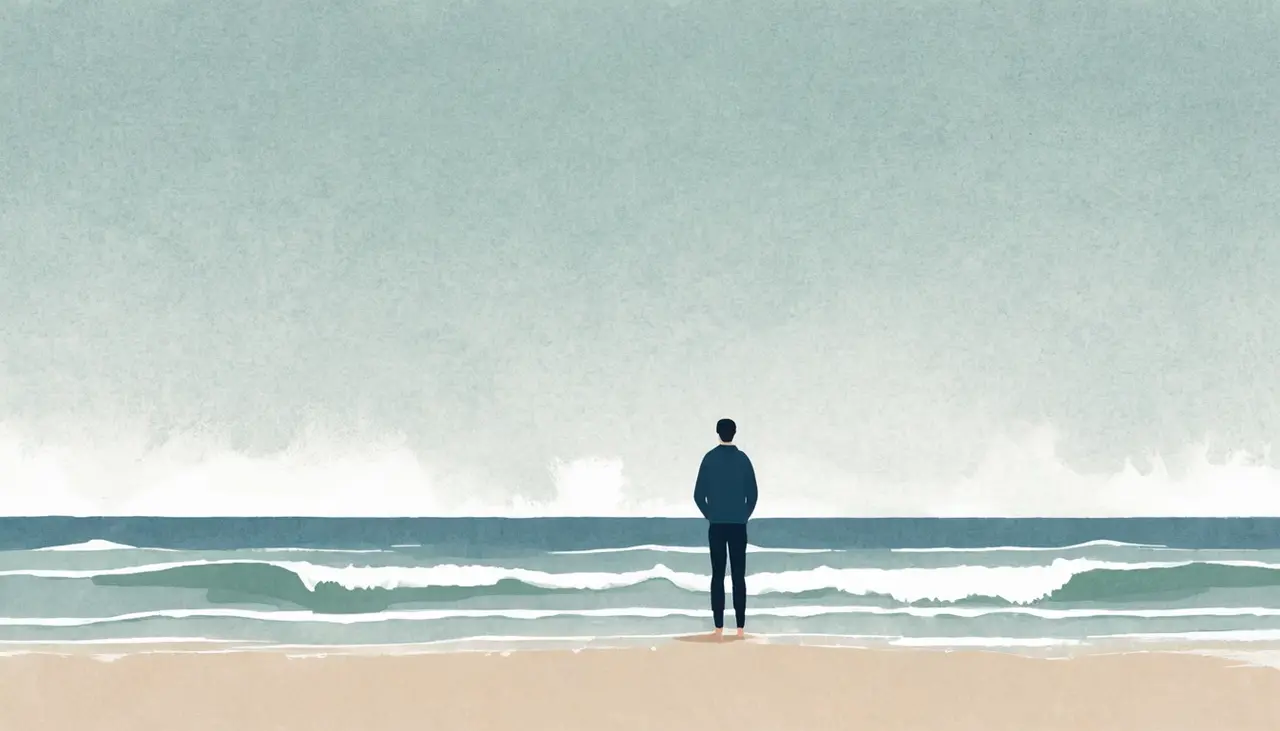
It is a little after nine, the house has gone quiet, and the want arrives the way it always does — not as a thought but as a pull in the chest, a low hum that says now, and don't overthink it. You already decided you were done for the night. The pull did not get the memo. It leans on you, and the leaning feels like proof that the decision was never real.
Here is the turn: the pull is not a verdict on you. It is a wave. And a wave, watched instead of wrestled, does something a promise can't make it do — it crests, and then it breaks.
This is a tool you can use tonight. Not more willpower, not a cleaner promise. A way to stand in the moment and watch the water instead of drowning in it. Call it the Wave Watch. If you have restarted more than once, the craving can feel humiliating, like it showed up to embarrass a decision you already made. It didn't. It just needs more structure than a private vow usually gives it, and the Wave Watch is that structure: four moves that turn "I need a drink" into something you can actually observe and outlast.
Why a craving behaves like a wave
A craving is not a steady state that grows until you give in. It builds, peaks, and recedes, usually within a stretch of minutes rather than hours — the same shape whether you feed it or not. What feels like "it will only get worse until I drink" is the front half of the wave being mistaken for the whole ocean.
That shape is why so much practical craving support, including SMART Recovery's public coping-with-urges material, treats an urge as a thing you can name and ride rather than a defect to hide. You are not trying to make the wave disappear. You are trying to still be standing when it passes on its own. Everything below buys you the time for that to happen.
Move one: name the wave out loud
The first move is to say what is happening, plainly, in the present tense: a craving is here, and it will pass. Naming it does two things at once. It pulls the feeling out of the fog of "I'm weak again" and into something with edges — a wave has a start and an end. And it puts a sliver of distance between you and the pull, enough to think.
Try being specific about the water you're standing in. Is this really about alcohol, or about relief, anger, loneliness, celebration, or plain fatigue? Is there a person, a place, a route home, or a screen habit attached to it? You are not solving anything yet. You are just refusing to let the craving stay a shapeless emergency.
Do it now: say one sentence in your head or under your breath — "This is a craving. It started around nine, after the day I had, and it will crest and fall." That is the whole move.
Move two: time the peak, don't fight it
Now put a clock on it. Not to grit your teeth, but to watch. A craving that feels permanent almost never is, and the fastest way to prove that to yourself is to notice it rise and start to ease while you do nothing but breathe and wait.
Pick a small, simple delay — the length of a glass of water, a walk to the end of the block, one song. The point is not to win a staring contest with the wave. The point is to collect evidence, tonight, that the peak passes without you doing anything to it. Once you have watched that happen even once, the next craving lies to you a little less convincingly.
Do it now: name the delay before you start it. "I'll fill and drink one glass of water, slowly, before I decide anything." Then actually watch the feeling while you do it.
Move three: change the frame you're standing in
Waves are bigger where the water is already churning. The same craving that owns you on the couch, in the exact spot and light and silence where the ritual used to happen, loses some of its grip when you move your body into a different frame — another room, the porch, the sidewalk, a phone in your hand and a real person on the other end.
This is not a distraction trick to feel clever about. Cues are physical. The chair, the hour, the glass in the cabinet's line of sight — they are part of what's generating the pull, so changing them changes the signal. A small language swap can move the frame too: I have to get through this quietly becomes I get to watch this one pass. That is not a slogan. It is a reminder that you are the one standing on the shore.
Do it now: physically change one thing. Stand up, step outside, or text someone the plain truth — "craving right now, riding it out." Moving the body first often moves the mind after.
Move four: log the water line
When the wave has passed — and it will have, by the time you read this back — leave yourself one line. Not an app entry, not a worksheet, not a perfect journal page. A single sentence in a note: "Craving hit around nine after the call with my brother, felt urgent, wanted relief more than taste, passed in about fifteen minutes."
That line is worth more than "I was weak again," because it is evidence you can read next time. Stack a few of them and the pattern shows itself: this wave keeps coming after work calls, or on Sundays, or when the house goes quiet. Then the question stops being "why am I like this?" and becomes "what does this specific cue actually need?" — which is a question support can answer.
Do it now: before you close your phone, write the one line while it's fresh.
When it does not work — and when it's not a craving at all
Some nights the wave is enormous and you drink anyway. One rough evening is not the verdict the shame wants to make it. It is one data point in a much longer stretch, and the Wave Watch works by accumulation, not by a perfect record. You keep the tool; you don't hand it back after one hard night.
There is also a line where this stops being the right tool at all. A craving that rides alongside real withdrawal — shaking, sweating, a racing or irregular heartbeat, fever, hallucinations, seizures, or deep confusion after cutting down heavy, regular drinking — is a medical situation, not a wave to ride. MedlinePlus describes alcohol withdrawal as symptoms that can appear after someone who has been drinking heavily and regularly suddenly stops, and it flags the dangerous ones. If those signs are present, this is an emergency: call 911 or go to the nearest emergency room now. Watching a wave is not the plan when the danger is physical.
And if the craving arrives tangled with thoughts of hurting yourself, or a night that feels genuinely unsafe to be alone with, put the tool down and reach for a person. The 988 Suicide and Crisis Lifeline is free and confidential, 24/7, by call, text, or chat. That matters more than any technique on this page.
For the quieter, non-emergency version — you keep riding out the same wave and you're ready to ask whether medication or ongoing care should be part of the picture — the next move is a clinician, not another app. If you do not have one to start with, Clero is building a way to connect with a licensed clinician by telehealth to talk through whether an option like naltrexone fits your situation.
Isn't "riding it out" just white-knuckling by another name?
It's the reasonable objection, so it's worth answering straight. White-knuckling is bracing against a craving with nothing but clenched effort and hoping you outlast it. The Wave Watch is close to the opposite: you stop bracing, name the thing, put a clock on it, move your body, and let the wave's own shape do the work of ending it. Effort still shows up — nobody is pretending the pull is gentle — but it is spent on watching and waiting, not on gripping. The difference is whether you treat the craving as an enemy to overpower or a pattern to outlast. Outlasting is less exhausting, and it leaves you with a note you can learn from instead of just a night you survived.
Tonight, if the pull comes back at nine, you already know its shape. Name it, time it, move, and write the one line when it's gone. The wave was never the whole ocean.
This is general education about a coping technique, not a craving protocol or medical advice; if drinking feels unsafe to stop, or you feel unsafe with yourself, use the emergency and crisis resources above before anything else.
- Medication & treatment
What is alcohol use disorder treatment online?
Online alcohol use disorder treatment provides remote access to medical care and behavioral support through telehealth platforms. In 2024, only 7.6% of people with alcohol use disorder received treatment. Private, medication-supported online programs address privacy concerns and access barriers for the 27.9 million Americans affected by alcohol use disorder.
- Medication & treatment
Changing Your Drinking Without Rehab: What to Know
Alcohol treatment does not always require residential rehab. Outpatient medication, counseling, and peer support offer different kinds of help.
- Quitting & sobriety
How do I stop drinking?
Stopping drinking starts with safety, not willpower. If you drink heavily every day or have had withdrawal symptoms, ask a clinician what level of care is safest before you stop suddenly. If you are medically stable, the next step is to choose support that matches your goal, privacy needs, and risk level: therapy, peer support, medication education, primary care, telehealth, outpatient treatment, or a higher level of care.
- Medication & treatment
Medication-assisted moderation: naltrexone, semaglutide questions, and app coaching
For medication-assisted moderation, naltrexone is the one built for it — semaglutide is still under study, and app coaching is structure, not medicine.
- Cravings & triggers
A Craving Management Toolbox That Is Not Just Willpower
A craving management toolbox is a few pre-chosen moves for when the urge is loud. Five handles: delay, distance, body state, support, and a next-morning reset.
- Medication & treatment
Common Myths About Medication-Assisted Treatment for Alcohol Use: What the Evidence Actually Says
Medication-assisted treatment is not trading one addiction for another. Six common MAT myths, corrected with FDA, AAFP, AHRQ, NIAAA, and SAMHSA facts.


Be the first to hear when Clero launches.
Join with email only. Clero is still in development, so this is educational content today — not treatment, a prescription request, or medical advice.
First to hear at launchLaunch news only — no spamUnsubscribe anytime